Performed by Darragh McLoughlin, a Berlin based, Cork born performer, Stickman is what it says on the tin. A man and a stick. McLoughlin moves about the space with the stick, making different images and becoming new objects. A television in the background narrates everything, telling us what to see. At times, the stick is left alone on the stage. This might seem a bit boring or weird, but it’s executed brilliantly, leading us to believe that maybe the stick is the main character after all? Afterwards, there was a Q&A session where plenty of interesting questions were asked by the audience.
This piece really shows us how to delight in the simple things. To make theatre interesting, funny and entertaining we don’t need big sets, sparkly costumes or pyrotechnic displays. All you really need is one man, a stick and a bit of imagination. In some cases, you don’t even need the man! What’s interesting about Stickman is how it personifies inanimate objects like a stick or a TV. The audience feels a human connection to them and get a sense of their “personalities”. Despite there being only one man on stage, there are three or four “actors”. Using this McLoughlin plays with our trust. One thing says to believe something, the other says not to. As a result, we get an overarching sense of evil, who is to be trusted? Stickman’s “Mr. Bean-esque” lack of the spoken word undoubtedly lends itself well to and international audiences. Which suits a piece touring around the world!
Stickman is hilariously funny for all ages. Its style of comedy is relatable to young and old. Afterwards, McLoughlin remarked how he started performing Stickman two weeks after its initial conception, to see what works well with audiences. As a result, Stickman is a well-oiled machine with every joke, jest and gag going down a treat. Stickman is also extremely dramatic theatre. As I have mentioned, we are emotionally attached to the characters by the end, and to see their fates unravel at the end pulls at the heartstrings. A Romeo & Juliet for sticks and televisions!
Altogether, Stickman is a must see for all. It is laugh out loud funny, eye opening and not your usual theatre. A big thank you to Townhall Arts Centre Cavan for facilitating the performance, Youth Theatre Ireland for sponsoring the tickets and Darragh McLoughlin for taking time to answer our questions afterwards.
Dean Cahill
Dean Cahill is a member of POD Youth Theatre in Co. Cavan and was a Young Critic in 2023.
From April 28th – May 1st 2020 the Abbey Theatre broadcast fifty short monologues as an immediate response to COVID-19 and the first lockdown in Ireland.
The brief was simple, What should Ireland write on a postcard to itself?
A whole year later, our newest group of Young Critics had the unique opportunity to revisit one of the pieces and watch it in isolation. Thanks to the generosity of the creators, the group had a private viewing of The Rock, written by Phillip McMahon and performed by Caoilfhionn Dunne.
We have a trio of short reviews from Anna Lynch,Evie Howard and Sarah Carolan for you to enjoy.
Image : Abbey Theatre
First up, Anna Lynch shares this review
The Rock by Phillip McMahon, part of the Dear Ireland project by the Abbey Theatre. Rating: ★★★★
The Rock poses to Ireland some uncomfortable questions, mainly how far have we as a society really come in terms of LGBTQ+ acceptance?
Written by Phillip McMahon and part of Abbey Theatre’s Dear Ireland project, The Rock is presented to us in the form of a video diary filmed by the only character. It’s recorded during a Covid-19 lockdown as a way of documenting the run-up to her wedding and to have as a keepsake for her future, but presently non-existent kids. We are privy to the troubles and turmoil the relationship between the character and her partner Carol have endured, see how internalised homophobia is still present in modern day Ireland and learn how important communication and co-operation are in relationships.
Caoilfhionn Dunne portrays the role of the angsty other half perfectly, capturing not only the essence of the lockdown madness, but also portraying the pressure of being a lesbian in Ireland. Taking into consideration the fact that the entire monologue is self-recorded and has no director, one has to applaud how smoothly the video runs.
The entire performance is intimate and personal, creating the illusion that the viewers are part of their lives. The script was outstanding, full of the Irish humour we all know and love. In particular, McMahon’s consistent references to rocks was extraordinarily clever when describing the feelings and thoughts of the character. It makes us think about how Irish views on the LGBTQ+ community and how indiscreet homophobia, even from loved ones, can have a profound impact on lives.
At times the monologue was perhaps spoken too fast, making it difficult to understand. However, overall, the short performance was excellent. This is definitely one to watch if you’re in the mood for some food for thought.
In this witty and realistic account of lockdown life in Ireland, Phillip McMahon tells an engaging and thought provoking story of a Dublin woman struggling with tradition, family, and identity.
The Rock was written as part of the Dear Ireland project, an initiative run by the Abbey Theatre in order to keep theatre alive during a nationwide lockdown. The idea is simple; 50 pieces written by 50 playwrights which were then self-taped by 50 actors. All the pieces were written with one theme in mind; ‘what should Ireland write on a postcard to itself?’
This theme is one that Phillip McMahon pulls off particularly successfully, raising a number of talking points about Irish society. In The Rock, we watch as the main character (played by Caoilfhionn Dunne) speaks directly into the camera in a way that feels very vulnerable and intimate. The piece is formatted as a video diary and we learn that she has proposed to her girlfriend and since revoked her proposal, telling a story of self-doubt and relationship troubles relatable to many. She also tells of problems with family, as she struggles to rebuild bridges with her homophobic mother. McMahon manages to pack a lot of information into the short few minutes of this piece of theatre while still keeping the dialogue natural, and Dunne makes a great performance, keeping consistent energy throughout.
As for negatives, of which there are few, the dialogue can be difficult to understand at times, especially for those unfamiliar with the Dublin accent, and the background is bland and can be distracting, but these issues are minor, and given The Rock was self-taped under unique circumstances, it can be forgiven. Overall, well worth the watch and I would recommend seeking it out should the opportunity to view it arise again.
The Rock- online performance for Dear Ireland- Abby theatre- written by Phillip McMahon- performed by Caoilfhionn Dunne
The rock is an insight into the stone cold society that we live in, with deep rooted beliefs that affect us more than we may think. A worthwhile watch that you, for sure, won’t take for granted.
The main character (played by Caoilfhionn Dunne) breaks the fourth wall, talking directly to the camera about her experience of lockdown through the format of a video diary. She tells us about the societal pressure she feels in everyday life and gives us an insight to how she makes decisions that affect her. She proposed to her girlfriend, but questioned what marriage meant to her. She tells us about the strain on the relationship with her mother, who has never fully accepted her sexuality.
Overall it was an extremely well put together piece. The subtlety of Caoilfionn’s performance was impeccable, to the point where it felt natural, as if she was talking to us through the diary. I also think the online medium was used to its fullest potential. Being able to adapt a story to the circumstances we find ourselves in, and not feel out of place, is a huge skill.
The design was simple and didn’t distract from the piece, but I wonder if a more cluttered backdrop could have reflected on the obstacles the characters have overcome.
With that said, it carries an extremely important message, making you examine the importance of “social norms” in today’s society.
Class will be returning to the Peacock Stage in January and Molly Foley from Activate Youth Theatre has this review from its October showing.
This new play, written and directed by Iseult Golden and David Horan is in many ways quite simple. The set is realistic and the plot is a straightforward narrative, with only three actors playing the five characters established in the piece. Despite this, Class is one of the most engaging, enjoyable and thematically-rich plays I’ve seen in a long time.
The story is that of two working-class parents, Brian (Stephen Jones) and Donna (Sarah Morris), who are called in to their son, Jayden’s school to talk with his middle-class teacher, Ray McCafferty (Will O’Connell). The parent-teacher meeting that unfolds is broken up with scenes of Mr. McCafferty’s interactions with Jayden and another student in his class during which Jones and Morris seamlessly take on the roles of the two children. These relationships develop and change as these characters deal with internal resentments and face a variety of issues that arise through the play.
Stephen Jones and Sarah Morris in Class. Photo Credit: Ros Kavanagh
The play manages do deal with issues of social class and notions of status subtly without hammering in an established opinion or belief. Instead, it is a perfect example of ‘show don’t tell’, starting a conversation through real, flawed and relatable characters, each with valid motivations, opinions and outlooks. It does not paint characters as ‘good or ‘bad’ and doesn’t depict anyone as in the right or the wrong. Those decisions are left in the hands of the audience and I believe that by the end of the 75 minutes, most viewers will have had at least one moment of sympathy and/or identification with each character in the play.
Class feels like a very down to earth play that knows what it is setting out to do and does it well without any self-importance. Although the plot develops in very unexpected and extreme ways, it never feels like it is being dramatic for drama’s sake.
At its heart this show is an exercise in empathy, not asking for audiences to choose or change sides, but just to listen and perhaps to briefly find themselves in the shoes of others.
I would consider this show a must see. With a sharp, well written script and stunning performances, this show is as hilarious as it is heartbreaking. Five stars.
Molly Foley is a member of Activate Youth Theatre and a Youth Theatre Ireland Young Critic for 2017.
Molly Foley, Activate Youth Theatre
Class returns to the Abbey Theatre for a limited run from January 24th 2018.
In the latest in our series of Young Critics reviews, Pierce McNee from Dundalk Youth Theatre traveled to London to see The Taming of the Shrew at Shakespeare’s Globe.
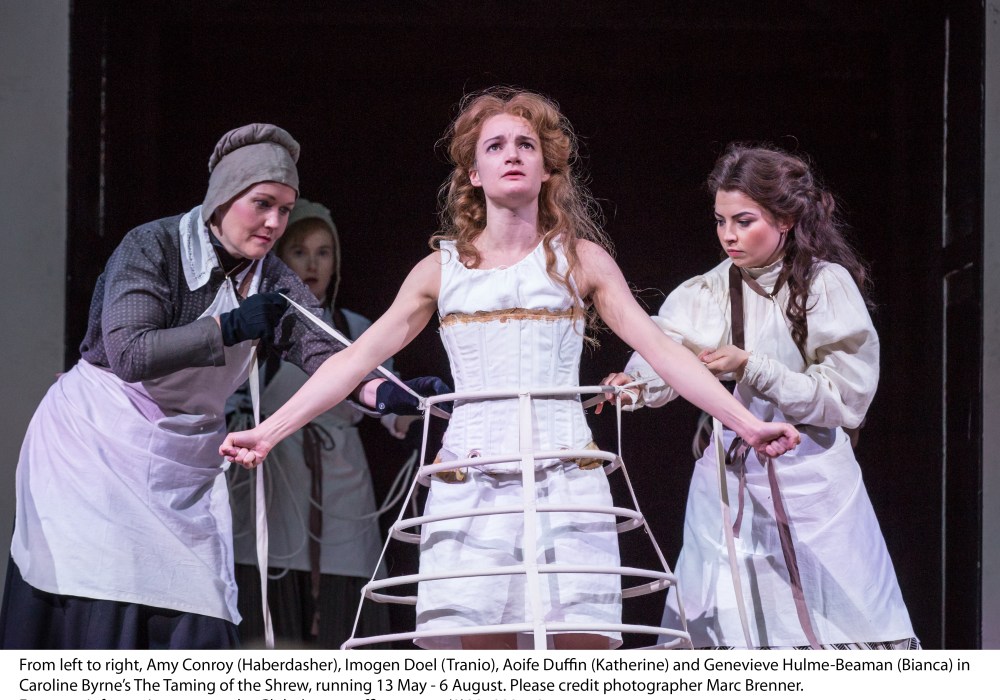
Cast: Aoife Duffin, Amy Conroy, Louis Dempsey, Imogen Doel, Colm Gormley, Aaron Heffernan, Genevieve Hulme-Beaman, Raymond Keane, Gary Lilburn, Edward MacLiam and Helen Norton
Set against the backdrop of Dublin 1916, this is a classic play with an alternative twist, featuring an all-Irish cast. This choice of setting — one hundred years after the events that sparked Ireland’s drive towards independence — makes the staging of this production extremely significant. Katherine (Aoife Duffin) appears on the stage at the start of play and sings, passionately, an Irish ballad written by Morna Regan (dramaturg and lyricist) especially for the production. This firmly establishes the 1916 setting and showcases Duffin as a standout performer and a force to be reckoned with.
The Taming of the Shrew tells the story of two sisters, Katherine and Bianca. Bianca is intensely keen on being married off to a handsome suitor. Katherine has no ambitions to become attached to a man. There is one problem: Bianca cannot marry before Katherine, a.k.a. the shrew, is herself paired off.
Going in, I was rather sceptical as to whether or not the production would cater for only an Irish audience, but it does not overly enforce the 1916 theme, which only becomes apparent on a few occasions. For example, a small fraction of the history is played out in the lyrics of Katherine’s two ballads. This make the theme subtly present throughout the performance but the production is kept grounded overall in the original story.
Caroline Byrne’s production is full of side-splitting antics whilst still exposing the serious and sometimes poignant aspects of the play. The misogynistic elements are portrayed with the earnest tone they deserve. The comedic facet is aided in particular by Aaron Heffernan as Lucentio, with his incredible physical comedy and natural wittiness.
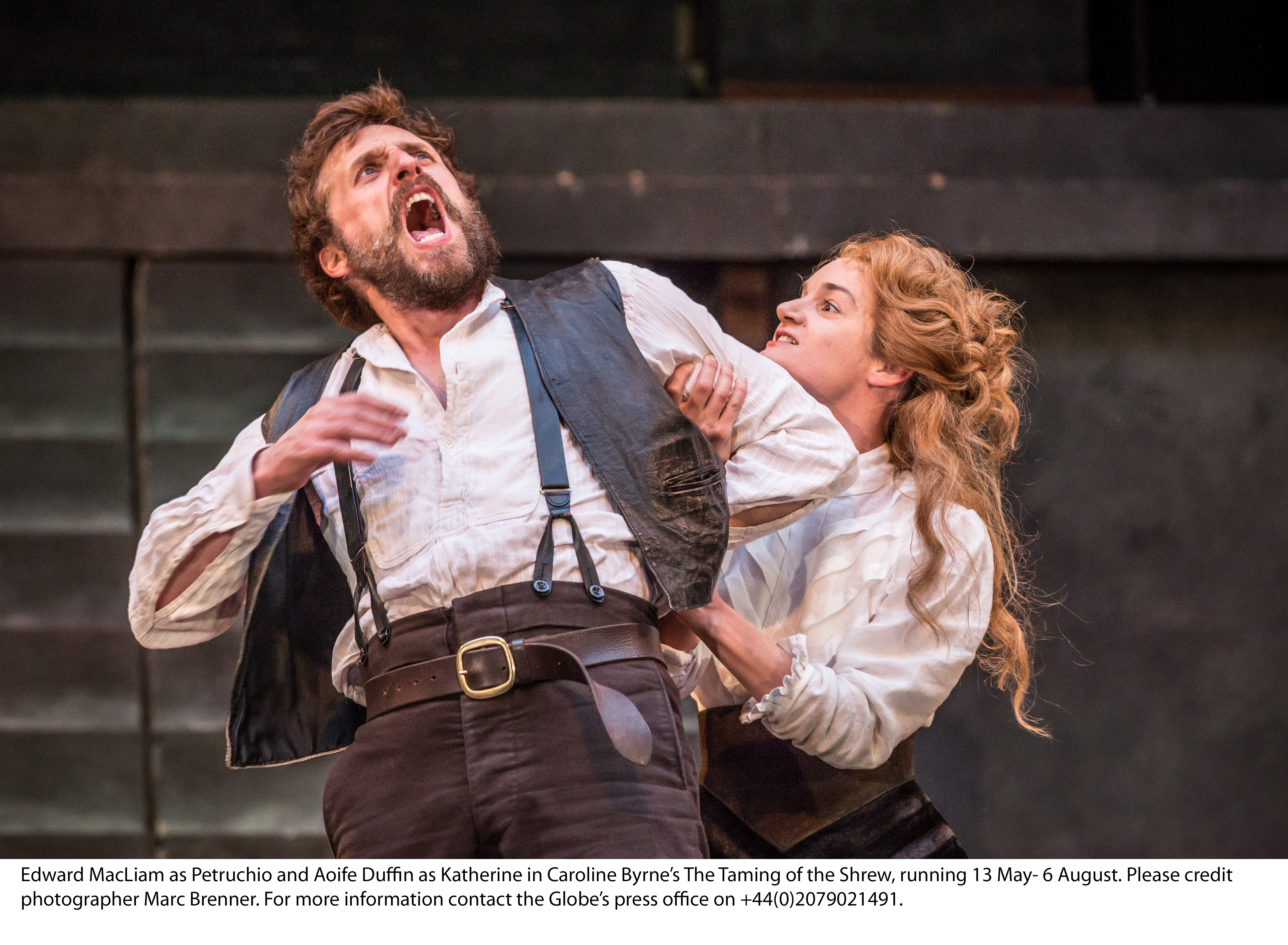
Other notable performances include Edward MacLiam as Petruchio, who offers a truly gritty portrayal of the character. He brings an amazing sense of tension with Katherine and this really keeps the audience on the edge of their seats for the intense scenes between them. Helen Norton as Grumio plays her character with great jocularity but also sincerity in the more sombre scenes.
The set, designed by Chiara Stephenson, starts with the traditional Globe stage design with its balcony and pillars. A large black structure is built into the opening at the upstage centre of the stage. This opens up at various points to reveal a staircase. At certain moments during the first half, the stage becomes a 1916 classroom as a prodigious abacus and an anatomical skeleton hurtle onto the stage. A pit of dirty water also appears at the downstage centre of the stage in which Katherine stands while singing one of her ballads.
The costumes, also in Stephenson’s more than capable hands, are eminently satisfactory and greatly fitting to the production. Many of the costumes are 1916-inspired with the women’s pieces heavily influenced by the Gibson Girl look. This also introduces the theme of women’s rights one hundred years ago and also in today’s society. The final speech, delivered by Katherine, allows us to reflect on how much has changed in terms of women’s rights since 1916, when women were so poorly treated.
Pierce is an NAYD Young Critic for 2016 and a member of Dundalk Youth Theatre in Co. Louth.
€22 million – the figure Eileen Gray’s Dragon Chair sold for in 2009. That’s all most people know about her. This production uncovers a great deal more than this fact, exploring the personal encounters in Gray’s life and sharing the accomplishments of this Irish artist with the Irish public.
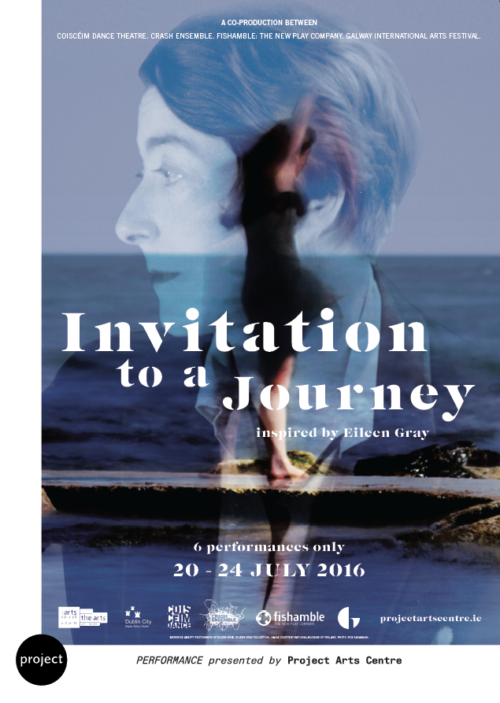
Invitation to a Journey explores Gray’s life in vivid detail, from her colourful relationship with Damia, her French lover (portrayed powerfully by Kate Brennan), to her innovative career as an architect and designer. It is a co-production of Fishamble: The New Play Company, CoisCéim Dance Theatre, the contemporary music group Crash Ensemble and Galway International Arts Festival, and is written and performed in a groundbreaking way. The roles of the three dancers, three actors, and four musicians are melded to the extent that in some scenes it is difficult to tell them apart, especially in one scene where Damia and the dancers fight over a chair, all essentially becoming dancers.
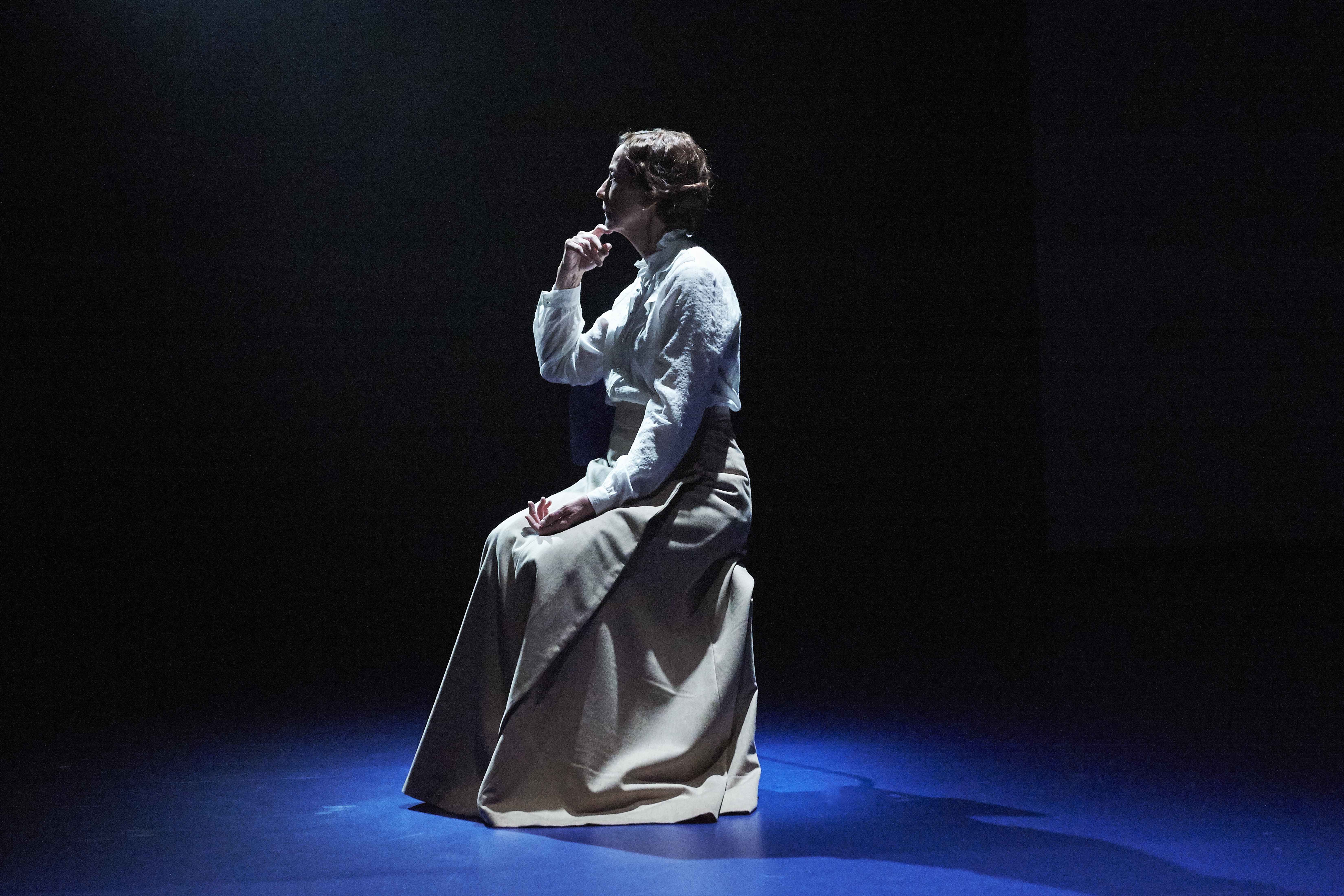
Invitation to a Journey. Photo: Ros Kavanagh
The musicians wear costumes suited to the era and have their hair crimped in a ‘20s style, which connects them to the dancers in particular, as they have the same hairstyle. (In the interest of full disclosure, I will say that my mother Deirdre O’Leary was involved in this production as one of the musicians).
The show opens with the three dancers offering their interpretation of Gray’s architecture through movement. Half a dozen nine-foot-tall doors on either side of the stage are then flung open by the remaining cast members, which segues into the auction of the dragon chair. As the cast bid for the chair, Ingrid Craigie — the actor playing Eileen Gray — sits in a chair behind them and becomes fleetingly visible as the bidders exit the stage and the lights dim. Her presence becomes much stronger as the show progresses, although at times that presence is overshadowed by the sheer amount of things going on onstage.
Halfway through, the show enacts the construction of e.1027, the iconic house Gray designed for herself and her lover the Romanian architect Jean Badovici. String outlining the foundations is taped to the stage by one of the dancers as Gray struts around the stage carrying blueprints. Only shortly afterwards, Le Corbusier (played by Ronan Leahy) paints lewd murals on the pristine walls of e.1027, nude.
In an era when most women were married off, Eileen Gray was openly bisexual, almost insanely driven, and creative. She was modern when it wasn’t mainstream and this show echoes that crazy creative determination that possessed her. While this show ambitiously melds the roles of dancer, actor and musician, it would be interesting to see what the difference in dynamic would be if the musicians had more dialogue with the rest of the cast and if Gray was more involved in scenes with the dancers. The mixture of concrete and abstract information presented through the different art forms gave a strong impression of someone’s personality. It seemed to be trying to express an inner creativity and drive that I now associate with Eileen Gray.
As part of the NAYD Young Critics Programme 2016, the Young Critics were tasked with seeing a production in their local venues and were then asked to create a critical response vlog. The Young Critics
They were encouraged to utilise their own programming eye and select work that they would then be able to create a critical response to. These critical responses take the form of short video blog reviews or podcasts, where they discuss the shows.
Since the start of May, the Young Critics have been seeing work and then writing, shooting and editing their own individual critical response vlogs. Some of these take the form of straight up critical responses, while others utilise comedy, drama and other techniques to respond to the work.
Two of the Young Critics, Mary Condon O’Connor from Fracture/ Play Youth Theatre in Tipperary and Colm Maye from Activate Youth Theatre in Cork reviewed The Weir by Conor McPherson.
As part of the NAYD Young Critics Programme 2016, the Young Critics were tasked with seeing a production in their local venues and were then asked to create a critical response vlog.
For the last three summers the NAYD Young Critics have been given the task of selecting a professional theatre production to see over the summer months.
The aim is to encourage them to see more theatre independently of the NAYD programme and create a culture of theatre going not only amongst the Young Critics, but also their wider youth theatre community.
Ideally it should be on in their local arts centre or venue and they are encouraged and supported to make a group booking for their own youth theatre to attend also.
NAYD, along with the participating local arts centres support this initiative through discounts, youth theatre group rates and the NAYD Go See YT Fund.
They were encouraged to utilise their own programming eye and select work that they would then be able to create a critical response to. These critical responses take the form of short video blog reviews or podcasts, where they discuss the shows.
Since the start of May, the Young Critics have been seeing work and then writing, shooting and editing their own individual critical response vlogs. Some of these take the form of straight up critical responses, while others utilise comedy, drama and other techniques to respond to the work.
What did they see?
In the last two years there were a large number of One Man/ One Woman shows touring the country.This year there were more medium scale touring productions on offer, perhaps suggesting that there is a broader range of work on offer. Or perhaps companies are being better funded then in previous years.
Decadent Theatre Company led the way with their production of The Weir by Conor McPherson, which was seen by three Young Critics in venues in Cork, Kilkenny and Limerick.
Chapterhouse Theatre Company from the UK toured their production of Sense and Sensibility to stately homes in Kilkenney and Kerry was reviewed by two of our Young Critics.
I was about to embark on what would be one of the best weekends of my life!
I had been hiking in the Mourne Mountains twenty four hours before this with my school and now I found myself on a bus to Dublin. I was about to embark on what would be one of the best weekends of my life!
I arrived on O’Connell Street an hour later and headed straight for McDonald’s where I waited in anticipation for what was to come.
We all met at the GPO. I was somewhat nervous at first as I didn’t know anyone, but after just a few short minutes I felt like I had known these people my whole life.
We then traveled to the Marino Institute of Education where we met with the rest of the group.
Next we got settled into our accommodation after which we had our first workshop in one of the lecture halls, playing games to get to know each other. We then had some extremely interesting discussions with Dr. Karen Fricker, a professional theatre critic, on topics such as what theatre is, the different jobs within theatre and what an outing to the theatre is like.
Later that night we sat and talked in the common room. We also had some tasty snacks and numerous cups of tea. I really enjoyed this as there was such a relaxed atmosphere and it was really easy to talk to everyone. We all got along so well.
On Saturday morning we were up and out bright and early for our second workshop where played games relating to movement in theatre and which emotions certain poses represent . We also played memory games. After this we researched the plays by studying photographs, casts, where it had been staged before and other elements of the plays. I found this to be very useful and greatly informative, as it gave me a greater understanding of the plays.
Kate Stanley Brennan as Nora in The Plough And The Stars. Photo: Abbey Website
Then it was time to make our way into the city centre to see our first play, “The Plough and The Stars”, by Sean O’Casey in the Abbey Theatre. It was a magnificent piece of theatre. There were also modern elements such as contemporary clothing in that specific production, as well as elements from the period in which the play is set. It was a hugely significant time to go to see the play as it was the one hundred year anniversary of the 1916 Rising and it was also the weekend of the actual Rising when we were in Dublin.
Afterwards we got to meet one of the lead actresses in the play which was just amazing. She told us about her experience of being in the play and talked to us about her career and how she feels about acting. We also got to ask her questions on those topics. Next we went for dinner and had some utterly mouth-watering pizza.
The time then came to see the second play of the evening. It was called: “Tina’s Idea of Fun”. I truly loved this play. It was a new play which was performed in the Peacock Theatre and it had only opened that Tuesday.
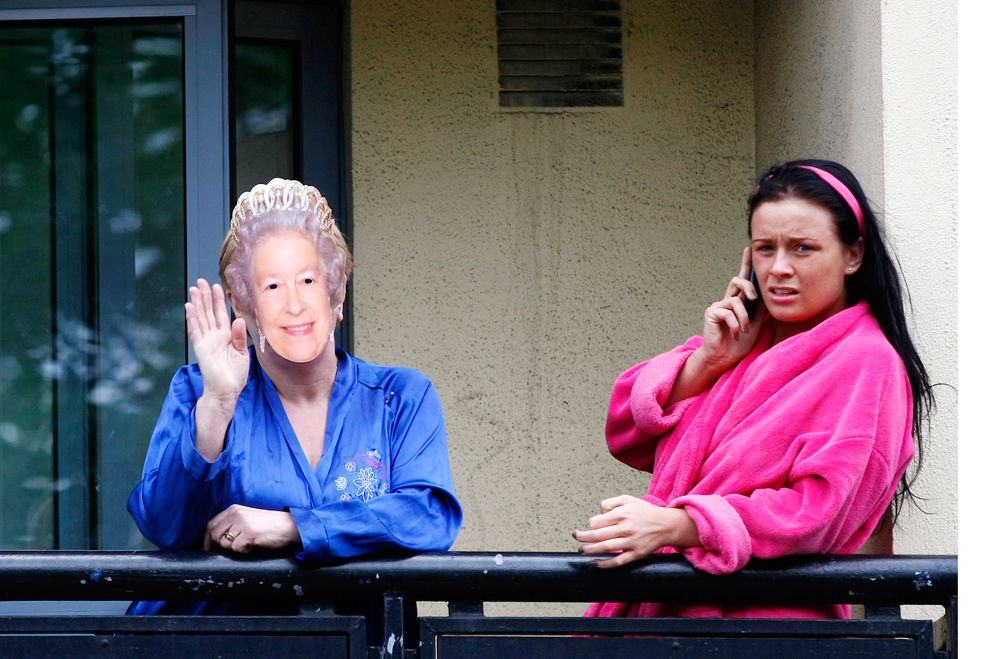
An image we used as part of our research into Tina’s Idea of Fun. This photo is from the Queen’s visit to Ireland in May 2011. Photo credit: Tim Hales/ Associated Press
Alan, the Youth Theatre Officer at the NAYD, had told us before the play began that we would be staying in the auditorium for a few minutes after the play had finished and I didn’t think anything of it at the time. However, when the play came to an end, Alan informed us that we would be meeting the whole cast! I was absolutely flabbergasted.
They sat on the stage and talked about how they got involved with the play and their feelings towards the play. We then got the opportunity to ask them questions. I asked them if they had any advice for aspiring actors and they all gave me the best advice that I could ever have asked for. This was probably my favourite part of the weekend as we were given a brilliant insight into the life of a stage actor and it definitely inspired me to just keep pushing myself as an actor.
The Plough and The Stars Photo credit: Ros Kavanagh
On Sunday morning we had our final workshop. In this workshop we discussed the productions we had seen the previous night. This was again very insightful and useful in coming to a conclusion as to my opinion on the the plays and the way in which I interpreted them.
Our last activity of the day was finding out what our project for the coming months would be. It will involve going to see a play with our youth theatres and then critiquing the production in the form of a video blog. I have already started working on the project and I am really enjoying the process of putting each component together to complete it.
This weekend was honestly a weekend that I will never forget. I learned so much about critiquing theatre, met lots of new friends and had such a magnificent time overall. Finally, I would like to thank Alan King, Dr. Karen Fricker and the welfare officers for a truly incredible weekend and I would like to thank the NAYD for giving me this once in a lifetime opportunity.












 Youth Theatre Ireland Young Critics