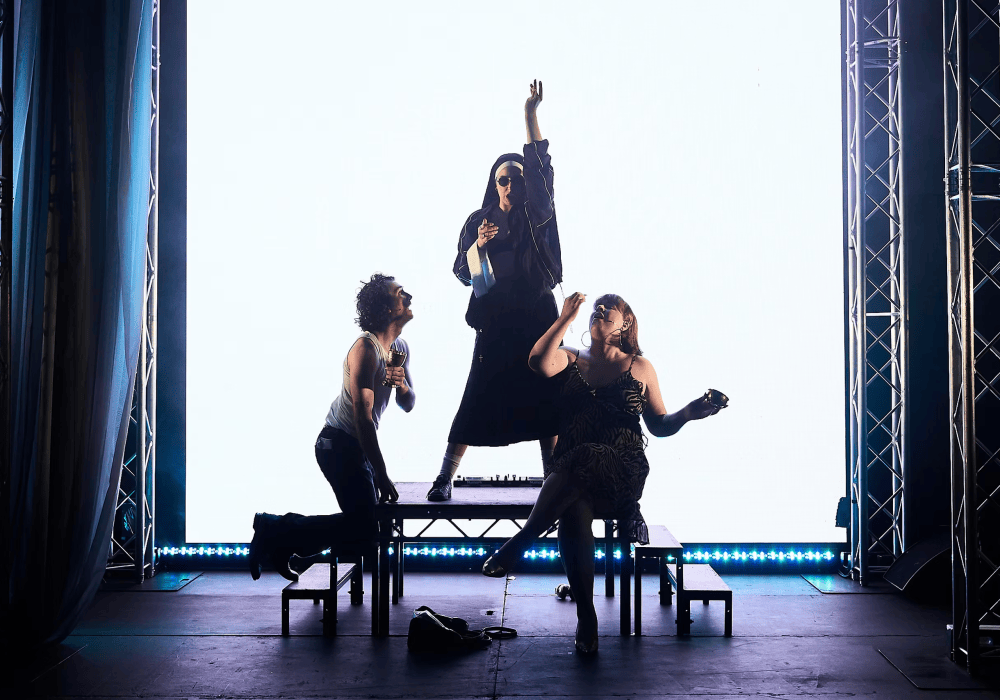
Riain Cash, Molly Lynch, Danielle James in Lourdes! The Musical by Xnthony Ltd. Image, Patricio Cassinoni

Review of Lourdes! The Musical

By Teegan O’Connell

It’s been a kitsch, camp and Catholic, two weeks at the Civic Theatre with the world

premiere of Xnthony’s Lourdes! The Musical.

Lourdes! Follows Matthew, an Irish actor working in London who is diagnosed as HIV

positive. This causes him to not get his ‘big break’. In order to cope with this loss and

revelation he returns to his hometown of ‘Countryland,’ Ireland, where he escapes to

Lourdes to join an amateur production of the story of Saint Bernadette. This production

changes Matthew’s life, forever and ever amen.

Despite opening with a debatably rushed exposition, with Matthew getting diagnosed with

HIV within the first five minutes, Lourdes! manages to expertly balance the fun and the

forlorn. It discusses the themes of queerness, illness, shame and transphobia throughout

without compromising on theatrics. Xnthony is scathingly blunt when writing typically taboo

topics such as death and illness, in a way which is extremely refreshing. Meanwhile, Riain

Cash’s flamboyant portrayal of Matthew lightens the atmosphere, allowing for such topics

to be discussed with stunning depth and nuance. Cash’s performance is a camp depiction

of theatre kid extravagance, which is in all ways iconic. His skill meets with Xnthony’s

writing to create a religious experience only ever felt by queer youth when they first

discover camp media.

Lourdes! is full of age-old clichés which add to it’s entertainment value. These can be seen

in the set and costumes, both of which are designed by Niall McKeever. The golden

seashell light covers at which characters both sing and pray transport the audience from

Tallaght to Broadway. All of the characters’ costumes from the casual sweatpants and

clerical collar combination worn by Father JB (skilfully portrayed by Iestyn Arwel), to the

over-the-top suits worn by Matthew during their production in Lourdes perfectly represent

their characters.

Directed by the brilliant Sarah Meadows with the acting of Danielle James, Molly Lynch

and Nichola MacEvilly, Lourdes! is a musical that I hope lasts long after the Dublin Theatre

Festival. It’s a musical that I believe will resonate with Irish audiences forever. Forever and

ever amen.

Teegan O’Connell is a member of Lightbulb Youth Theatre in Mallow, Co. Cork and a young critic for 2026.
It’s Written On The Wall

By Rory Moore

We stand in the place of our forefathers,
A lineage of political prisoners,
Prisoners persecuted by putrid people preaching poisonous propaganda and peddling pestilence.

Our crime?

A man burned to protest being ignored.
We screamed and cried and we wept and mourned.
We ripped up the street that was designed to suppress.
I guess it was our fault the tank introduced our face to the ground.

They buried us.
But because we were seeds, we grew.

Rory Moore is a member of Griese Youth Theatre in Co. Kildare and is a Young Critic for 2025.

This poem was inspired by the show “Nowhere” by Khalid Abdalla seen at Dublin Theatre Festival 2025.

Scattered Sideways Review

By Grey O’Brien

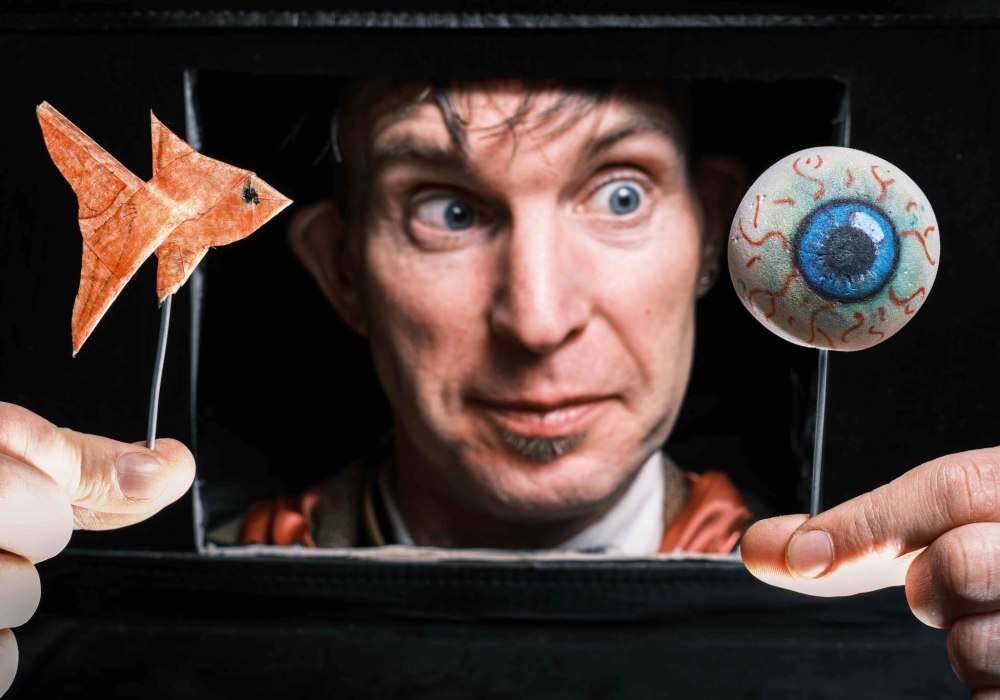
On our last Young Critics trip to Cork, we went to see the surrealist, immersive, one man show called Scattered Sideways, written and performed by Will Flanagan. The show was confusing, dream-like, and as the name suggests, scattered feeling, in the most bizarrely effective way possible. I personally found it to be brilliant in its concept and execution alike. It managed to do an incredible amount of storytelling and character development, all with amazing messaging, in the hour we spent watching it.

The show, a mix of physical theatre, circus, poetry and film all in one, took us along a winding, confusing, yet interactive and engaging journey. While talking about it, it can be split into two main parts. The story, and the performance. Throughout the show, Will Flanagan inserted pieces of a story between the various scenes of poetry, circus performance and theatre. This story followed a goldfish, trapped in a tiny fishbowl, floating through a seemingly endless sea of polluted, murky water. It was told like a children’s fairytale, and chronicled the lonely life of the goldfish as he watched the world outside of his clean, safe fishbowl. The show was interrupted every few minutes to continue the story, which I thought broke it up in an effective manner. Without it, the moments of high strung tension would not have felt as important as they were with the slow, childlike story to bring the intensity to a halt between scenes.

The other side of the metaphorical coin was the performance aspect. We watched Will Flanagan as he executed a dozen performances, each one more intense and draining than the last. These included walking a tightrope, juggling and balancing towers of skittles on himself and on each other, a gorgeous light show, a spoken word poetry act, and much more. We followed the character as he desperately tried to impress his audience, us viewers, with bigger and more intense tricks and performances, while he battled to hold their attention. Throughout the show, projected, fast paced clips, intriguing sets and frantic sounds and noise all served to capture our gaze, while Will Flanagan’s character tried desperately to outshine it all and bring the attention back on to himself.

Each act served a different purpose and represented the different aspects of the struggle his character was experiencing while trying to keep up with the quick moving sensory nightmare of the world he was in. His acting was mostly physical, yet, without needing words he expressed impressive amounts of emotion through physical theatre and body language. At times it was hard to believe he wasn’t talking at all. It was so well done, it felt like I was getting a look inside the deepest, most vulnerable part of the characters soul, all without a single word being spoken.

Grey O’Brien is a member of WACT Youth Theatre in Co. Wexford and is a Young Critic for 2025

Review of The Bród, The Bold, and The Beautiful

By Alisha McGarrity

The Bród, The Bold, and The Beautiful was a physical theatre performance devised by the Quintessence theatre as a part of the local towns pride celebrations. They performed in An Táin Arts Centre on the 27th and 28th of June as a part of Dundalk pride events.

This play had a very minimal set consisting of only 3 chairs which were moved around to disclose the location of that scene, for example they used them to make a bus, lining up to face side stage and they created an image of a couch by pushing the three together.

The play explores the experience of 3 different queer people based in Ireland all of whom grew up in different times, therefore their journey through discovering and accepting their queer identity varied wildly.

One of them was a young adult in 1993 when the law causing homosexuality to be illegal was overturned and he had to deal with the homophobia which ran rampant at the time.

Another story explored was one of a queer woman, who was a young adult in 2015, who tried to help to get people to vote yes to the 2015 marriage referendum after she couldn’t see her girlfriend in the hospital because civil partnership didn’t allow the same rights as marriage does.

The last story was one of a queer person, in current day who was struggling with their gender identity and not feeling as though they belonged even in the LGBT community due to the transphobia which is so common these days. Their story explores personal acceptance and the exploration and change of relationship which occur when one partner is transgender, both binary and non binary.

These stories all started and concluded at the same place, Dublin pride. It opens with them all talking about their first pride and it closes with the three of them meeting at pride in 2024. They end up celebrating the change which has occurred and remembering the future changes that need to be made to make the world safe and inclusive for all queer people. This story was explored through several short monologues, scenes and movement sequence to explore each of the characters personal journeys.

My personal favourite scenes was when the queer woman was going door to door attempting to get people to vote yes in the referendum and having various positive, neutral and mostly negative interactions, she asks an older person would they be willing to vote yes and she responded she absolutely would as it was not her business to stand between two people who loved each other. I really enjoyed this scene as it was not only a really sweet moment but it was one where I could see what the lives and struggles of queer people was like in the generation above mine.

I really enjoyed this play as it explored such rich and interesting stories in a beautiful way. The lows and the sad parts of the play were matched with highs and funny sections which made almost everyone in the audience laugh. I fluctuated from crying to laughing to crying then laughing again throughout this play in the best possible way. I wish I could have seen this play again I loved it.

Alisha McGarrity is a member of M.A.D. Youth Theatre in Co. Louth and is a Young Critic for 2024.

Some Words on Elles Vivent at Dublin Theatre Festival

By Dearbhla McCormick

The play ‘Elles Vivent’ (EV) is a remarkably funny and frank production that examines our modern norms by heightening them to their inevitable ridiculous conclusion.

For some background information EV was originally conceived by Antoine Defoort and then collaborated on by Lorette Moreau. It was performed by the aforementioned Antoine Defoort as well as, Sofia Teillet, Alexandre Le Nours and Arnaud Boulogne, with The Spirit of the Forest as logomorphic adviser and engineering of the Fliflifli Reform by Kevin Matagne. Oh, and if list wasn’t setting off any senses, it’s entirely in French.

The story goes as such; in the future, an indeterminate amount of time (+2 years) away, two friends, Michel and Taylor, meet in a forest to discuss their lives over the past years. Michel has spent two years in a deep mindfulness isolation and so has plenty of questions regarding the current state of the world to ask his good friend.

One of the most pressing themes present within EV is the relationships that we have with our ideas, modalities and societal norms. From the absurdity of our modern customs to the almost autonomous life and strength we give to ideas simply by thinking of them. EV treats ideas and concepts as living things that are hard to kill and will naturally defend themselves. Such as, the concept of fear. EV describes the idea of fear as something you push away behind a fridge or at the back of a cupboard, but, in the effort you take to try and forget this fear, to kill it, this idea, it grows in strength, out of sight but looming, breathing down your neck. In answer to this EV suggest (by means of musical prose no less) that by acknowledging all of our ideas equally, ‘by giving them a seat at the table’, and acknowledging the fact that we ‘Are super scared’, it removes the threat they pose, giving them nothing but a passive influence on our lives.

But let’s hang on that musical prose part for a sec’ because it gives me an excellent segue into one of the best parts of this play, that being; the funny. Hands down EV contains a fantastic sense of comedy throughout, often pairing it with serious thoughts and concepts to create a paradoxical situation in which you both believe completely in what they are proposing while simultaneously laughing your head off at it, or as they more deftly describe it, ‘Holding two opposing truths at once’. Such as ‘The Stick Prayer’, a mindfulness activity proposed in universe that despite lucridity of it, works. And it is this mixture of paradox and comedy that I believe keeps audience members open to conversation and discussion of these ideas.

But it’s not just the story that is cause to this brilliant piece of art. Designed by Marie Szersnovicz, EV’s constant backdrop of a beautiful forest scape gives the story an almost timeless sense despite being set in the future. The projecting screen set in the middle of the stage ensures that your eyes are neither carried too far away from the characters nor the subtitles, as well as providing story relevance by setting the scenes in the memories.

The crowning jewel though, what I believe shows that true care and attention has been put into this play is the feature of the nmemoprojector. The simple prop slash plot device in question allows the wearer to view any memory that they may recall. Not only does this provide a quick way to jump between multiple points in the past two years, but what I love is the clarity of the memory has an effect on the viewing. Backgrounds may be blurred or simply just a colour gradient, furniture is reduced to simply geometric shapes, at one point a character’s recollection fades to just the emotion that they felt at this time, so nothing is projected, but the accompanying music swells and fills the theatre, letting the feels wash over you in one of the only languages where fluency is unrequired.

When all is said Elles Vivent is a brilliant think piece that dissects our norms and tackles interesting issues within the self while also managing to be an absolutely hilarious in an ingenious performance.

Dearbhla McCormick is a member of Monaghan Youth Theatre and is a Young Critic for 2022.

Review of Guests of the Nation

By Ethan Mallon

Photos by Enrique Carnicero

Derived from the Frank O’Connor short story published in 1931 and first adapted to the stage by Neil McKenzie in 1958, Guests of the Nation made its way to the stage once again for the Cork Midsummer Festival in June. Brought to life through the talents of director Pat Kiernan and writer Kevin Barry, this new adaptation both instilled its own distinct flavour to the casting and direction whilst still retaining the spirit and bite of O’Connor’s original work. Set during the Irish War for Independence, Guests of the Nation chronicles the story of 4 soldiers; two Irish, two British, as they struggle with the trials and tribulations of the war whilst inevitably hurtling towards the death of the latter by execution.

Right from the word go I was engaged by the stark humanity portrayed in the imprisoned British soldiers as they grappled with their impending fates. Whereas the majority of works depicting the War for Independence would entirely portray the British in a negative light, Barry’s script offers a more morally grey portrayal of the Brit’s, bringing into question the morale of the IRA ironically. This is not to imply that the former approach is inherently a negative, see Ken Loach’s The Wind that Shakes the Barley for what can be achieved with such an approach, but to put emphasis not on the frankly psychotic slaughter of civilians often enacted by the Black & Tans but instead the humanity of those caught up in the torture and bloodshed that ultimately had no direct ties to such barbaric actions was an impressive and bold choice.

Of course a distinct element of this adaptation I have otherwise overlooked thus far would be the all-female cast with Gina Moxley, Liz Fitzgibbon, Amy Conroy and Chloe O’Reilly portraying the IRA and British soldiers respectively. Any potential scepticism was swiftly dashed out as the play began proper, as all four women did a phenomenal job engrossing me into the narrative. I can’t say for certain whether this was a direct decision by the creative team, but it made me think during and after the show about how certain gender archetypes influence how people may make casting decisions. This isn’t to say that masculine men or feminine women for instance aren’t still present in the modern world of course, but the assumption that everyone of both genders only fall into certain demographics is simply misguided, something this show fortunately goes against the grain on.

Another key aspect of this iteration of the story is that it is not squarely resigned to the stage for its entirety, rather the audience is taking across the city of Cork much as the characters go across the Irish countryside. Not only does this result in an incredibly distinct vibe to the proceedings than I have ever seen in any stage production thus far, but it also allows the audience some time, albeit brief, to muse on the characters actions and the trajectory of the narrative. It’s not as if most stage shows don’t have a standard intermission of course, but those are usually during the middle point. By making the audience go from place to place at three separate intervals gives more instances to ponder on the story at hand and what is trying to be conveyed.

Overall I’d say that this new iteration of Guests of the Nation has more than surpassed my expectations. Through adapting O’Connor’s new work whilst integrating their own distinct elements, Kiernan and Barry have simultaneously revamped the show in some ways for a modern audience whilst still retaining the spirit of the original short story, of which still retains a strong potency a little over ninety years after its first publication.

Ethan Mallon is a member of Act Out Youth Theatre in Co. Meath and is a Young Critic for 2022.

Review of A Safe Passage

By Andrew Keegan

Photo by Marcin Lewandowski

On the surface, “A Safe Passage” is an uncomplicated, transparent tale of a humble lighthouse keeper, a troubled young adult, and how the two come to form a deep, unlikely relationship that will ultimately change both of their lives, forever. 
 
“A Safe Passage”, written by Irene Kelleher and directed by Geoff Gould, follows two protagonists. Christy, played by Seamus O’Rourke, is a reserved and unremarkable man, who lives out his days guiding those at sea. Alongside Christy, we also follow a peculiar and unpredictable young woman known as Marilyn, played by the formerly mentioned Irene Kelleher. Throughout the sixty-minute run time, we watch as the two gradually begin to develop a bond as the pair come to know more about each other and their past. 
 
 
The production is set in 1979, New Year’s Eve, and immediately I must commend the set designer, Hannah Lane for her clever inclusion of props and other objects, such as the long-outdated radio and lantern. The use of these props allows the audience to comfortably immerse themselves fully into the show.  
 
As well as the set production, audio design plays a vital role. Sounds effects such as the crackling of the radio, can be used to convey a sense of isolation and loneliness. Another example includes the exaggerated rattling of the spilled pills hitting against the floor, which creates an uneasy atmosphere among the audience. 
 
“A Safe Passage” explores many themes throughout its duration, these being, ‘the devastating effects of isolation’, the ‘importance of human connection’, and ‘overwhelming guilt’. In my opinion, I feel that not only does the production convey these themes effectively but does so in a delicate manner as they are real world issues that affect countless people.  
 
At its core, “A Safe Passage” is a gut-wrenching, somber story of two individuals embracing their sorrow together. With passionate acting, black comedy and a gripping plot, every audience member is bound to leave the theatre astonished and wholeheartedly satisfied.

Andrew Keegan is a member of Fracture Youth Theatre in Thurles Co. Tipperary and is a Young Critic for 2022.

Introducing the Young Critics 2022!

Youth Theatre Ireland are delighted to announce this year’s Young Critics from 14 different youth theatres across the country!

The Young Critics is one of Youth Theatre Ireland’s longest running programmes and sees 16 youth theatre members come together to learn about theatre criticism and response. The programme this year is led by Alan King, Rebecca Feely, and esteemed academic and theatre critic Dr. Karen Fricker.

The Young Critics 2022 are:

MaryJane O’Connor O’Leary, Activate Youth Theatre, Co. Cork

Dearbhla McCormick, Monaghan Youth Theatre

Liam O’Neill, Dreamstuff Youth Theatre, Co. Kilkenny

Yasna Tofail, Limerick Youth Theatre

Helen McCarthy, Explore Youth Theatre, Co. Kildare

Chaya Smyth, Dublin Youth Theatre

Cian Griffin, WACT Youth Theatre, Co. Wexford

Amelie Prone, Kildare Youth Theatre

James Acheson Dennehy, Stagecraft Youth Theatre, Co. Tipperary

Keeley Guilfoyle, Clare Youth Theatre

Andrew Keegan, Fracture Youth Theatre, Co. Tipperary

Ethan Mallon, Act Out Youth Theatre, Co. Meath

Mia Clinch, Sligo Youth Theatre

Molly Crilly, Act Out Youth Theatre, Co. Meath

Nneka Okosi, MAD Youth Theatre, Co. Louth

Becca McGlone, Sligo Youth Theatre

This year the crew have already been to the Cork Midsummer Festival where they saw A Safe Passage by Irene Kelleher, Guests of the Nation by CorcaDorca, and they also had the opportunity to see some visual art installations across the city.

The Young Critics will come together again from October 7th-9th for Dublin Theatre Festival, and the weekend will culminate with a panel discussion at The Project Arts Centre on October 9th at 1pm. Tickets are free and you can find out more on Dublin Theatre Festival’s website.

You can find out more about the Young Critics programme and other programmes for youth theatre members here.