NAYD’S Young Critics hit Dublin for 1916/2016 by Jack Synnott

Young Critics was an absolutely unforgettable weekend filled with everything a theatre loving 16 year old could ask for.

NAYD Young Critics 2016

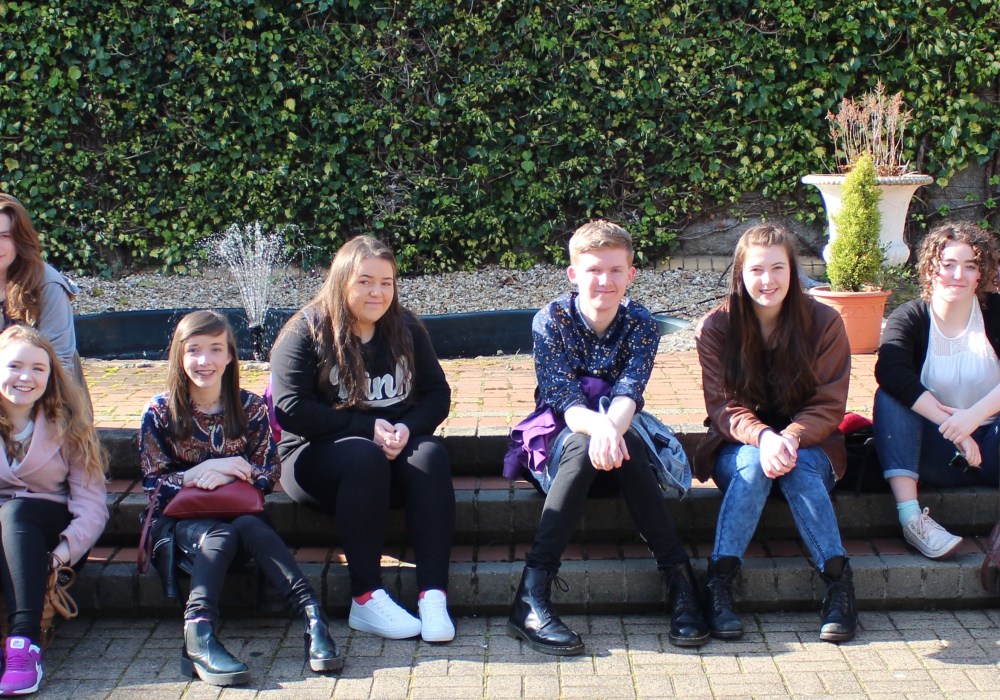
NAYD’s Young Critics 2016. Photo credit: Alan King

Upon arriving at the Marino Institute of Education, our temporary lodgings for the weekend, we were treated to two great introductory workshops with co-ordinator Alan King involving a wide variety of drama games, helping us to get to know each other. After that we had some enlightening discussions with the fantastic theatre critic and scholar Dr. Karen Fricker, about every aspect of theatre and criticism from the making of theatre and its function to the duties of the theatre critic.

We then journeyed back to the common rooms for some late night chats and cups of tea before we hit the proverbial sack to get some much needed rest.
IMG_5193 (1).jpg

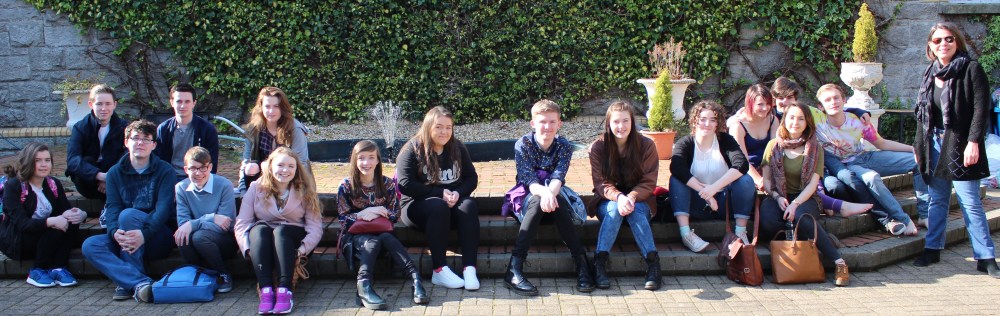
NAYD’s Young Critics enjoying the sunshine at The Marino Institute of Education. Photo credit: Alan King

The next morning we embarked on what was probably the most unexpectedly enjoyable part of the weekend: the research. This involved rooting through a variety of articles on the themes, settings, context and creative teams behind each of the two shows we would be seeing that afternoon.

This really helped us to get a solid grasp on what to expect from the plays and it was interesting to see the similarities and differences between the two. We also did some work on the differences between objectivity and subjectivity and the importance of description, through more drama games, which was a fun way to hone these invaluable skills.

That afternoon we took the bus into Dublin to see the first of our two plays, Sean O’Casey’s The Plough and the Stars on the Abbey Stage. This was a really interesting take on an Irish classic, with director Seán Holmes really pushing the boundaries and gleefully playing with our expectation of such a revered piece.

IMG_5199

Janet Moran (Mrs. Gogan) meets the Young Critics after the matinee of The Plough And The Stars. Photo credit: Alan King

Afterwards we had the honour of meeting Janet Moran, the actor who played Mrs. Gogan. Through our discussion with Janet we gained a huge insight into the play, and how many of its ideas took form throughout production.
IMG_5200.jpg

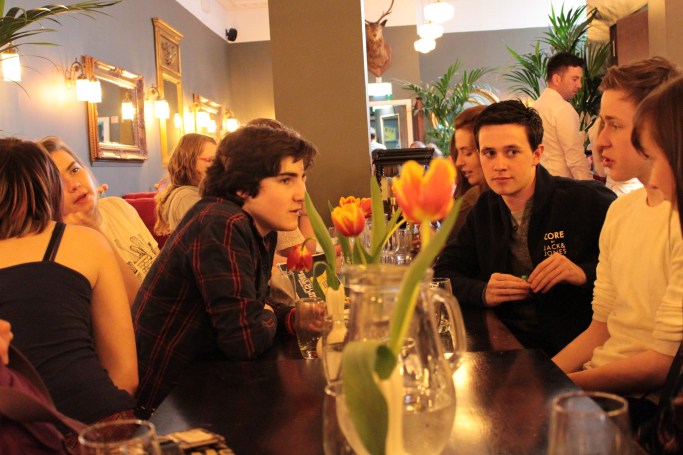
NAYD Young Critics enjoy some intense post show discussions over dinner. Photo credit: Alan King

After a brief excursion to the Jervis centre and a gorgeous dinner, we returned to the Abbey Theatre to take our seats for the new play showing on the Peacock Stage, Tina’s Idea of Fun by Sean P. Summers.
IMG_5210.jpg

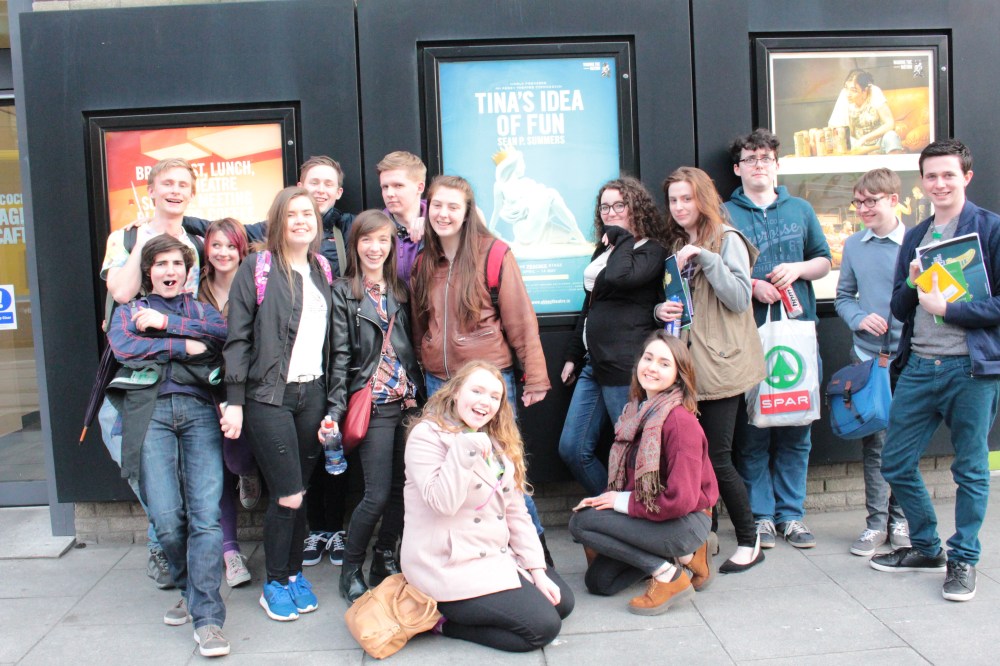
NAYD’s Young Critics arrive at the Peacock Theatre for Tina’s Idea Of Fun. Photo credit: Alan King

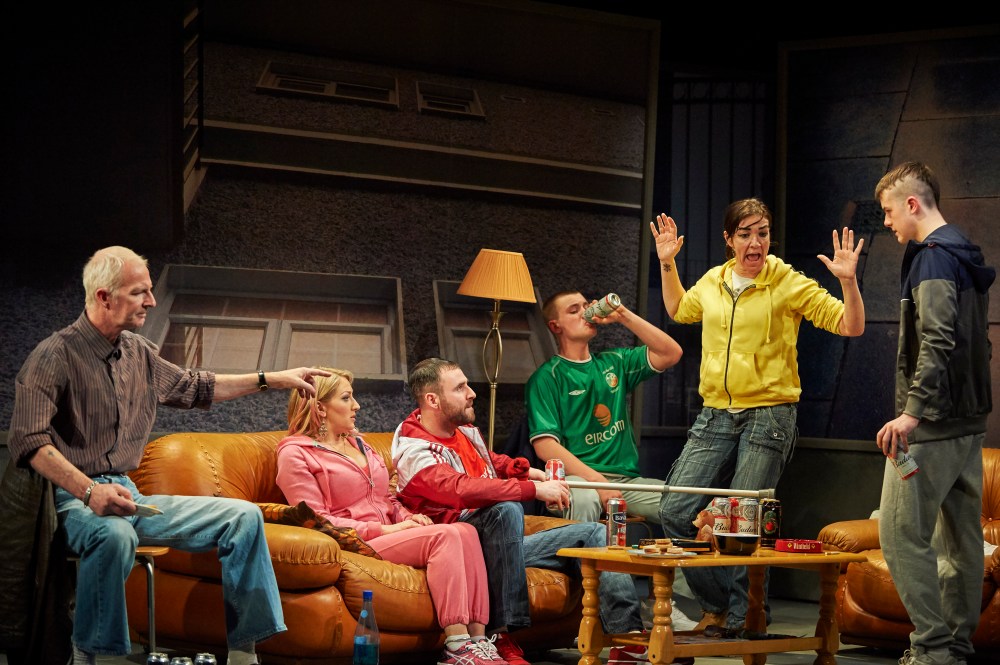
Set against the backdrop of Queen Elizabeth the Second’s visit to Ireland in 2011, this very funny  play asked questions about modern day republicanism while simultaneously examining the difficulties of motherhood and the dangers of isolation.
1B.jpg

Cast of Tina’s Idea of Fun by Sean P.Summers. Photo credit: Ros Kavanagh

Andrew Connolly (Paddy), Sarah Morris (Edel),Keith Hanna (Dave), Josh Carey (Bundy), Hilda Fay (Tina) and Scott Graham (Aaron) in Tina’s Idea of Fun by Sean P. Summers. Directed by Conall Morrison.

Featuring excellent, honest performances and a subtle, quiet script, this piece directed by Conall Morrison was hugely enjoyable. Immediately afterwards we were treated to a Q and A with the entire cast, an amazing opportunity that was both great fun and incredibly informative.

We finished off our action packed day with a group selfie on the bus and the wonder of cake before we retired once again to bed.

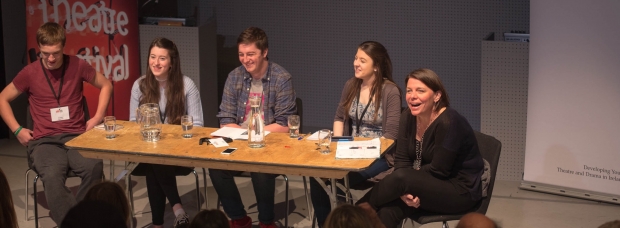
Sunday, the final day of the weekend was filled with emotional goodbyes and happy reminiscing, but we still found time for two panel discussions, dissecting each of the previous day’s productions.

IMG_5219.jpg

A Young Critic’s thoughts on The Plough And The Stars. Photo credit: Alan King

This was a brilliant morning, as we really got to get into the meat of what we had seen, debating every element of each of the shows and occasionally being shown an entirely new angle on certain aspects. It was great to be able to discuss the plays in such detail, with a group of people just as interested in them as you, and I left that workshop with a much deeper understanding of the plays than I had going in.
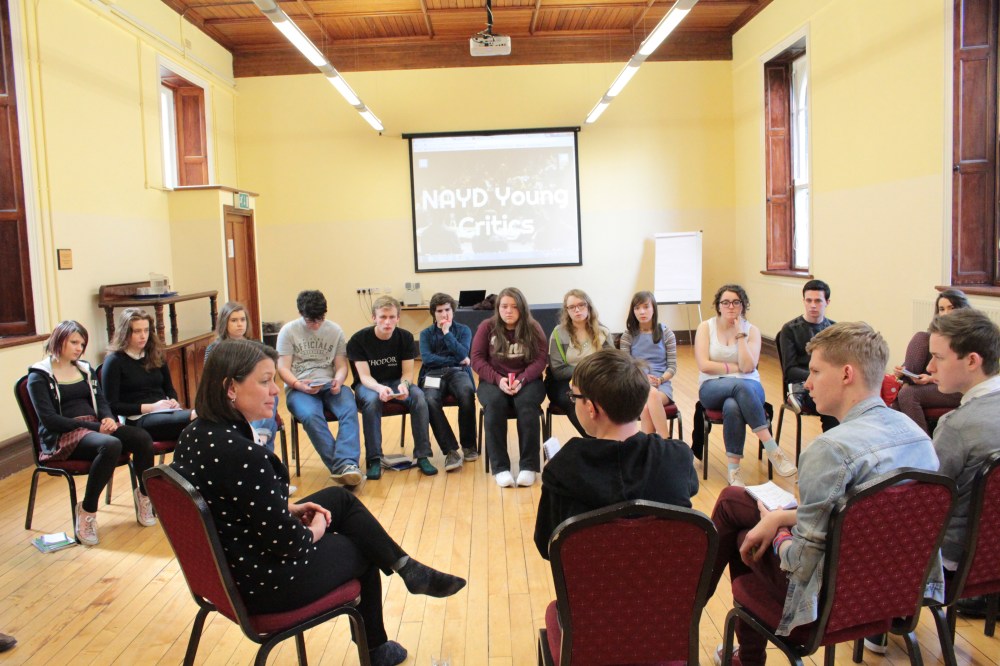
IMG_5247.jpg

Dr. Karen Fricker listens on as NAYD Young Critic Jack Synnott gives his thoughts on the productions under discussion

All that was left was for us to learn our assignment for the summer, to create a video blog reviewing a production in our local venue, and to say our goodbyes. It was sad to leave everyone behind, but we knew that we’d be back again in October.

I don’t think I’ll ever forget the weekend at Young Critics, I saw some great plays, met some amazing people and learned some invaluable things. Roll on October!
 

final .jpg

Jack Synnott is a member of Droichead Youth Theatre  in Drogheda, Co.Louth and an NAYD Young Critic for 2016

NAYD Young Critics Announced for 2016

A big thank you to everyone that applied for Young Critics.  This year the number of applications was an even bigger increase on last year’s applicants. We got a record breaking 47 applications for just 16 places.

DSC_0695_620_412

NAYD Young Critics 2011 at Project Arts Centre 

We are happy to announce that the Young Critics for 2016 are:

Colm Maye Activate Youth Theatre
Jane Byrne CYT – CYT – Cabinteely Youth Theatre
Savana Bartual Smyth Cork Institute of Technology – CIT
Rita Havlin Donegal Youth Theatre
Meabh Hennelly Dublin Youth Theatre
Jack Synnott Droichead Youth Theatre

Louis Flanagan Droichead Youth Theatre
Pierce McNee Dundalk Youth Theatre
Patrick Joy Footsteps Youth Theatre
Clodagh Healy Free Radicals Youth Theatre
Kate Brady Gonzo Youth Theatre
Emily McGee Kilkenny Youth Theatre
Ryan Finnegan Leitrim Youth Theatre Company Carrigallen (LYTC)
Ciara Lummis Play YT / Fracture Youth Theatre
Mary Condon O’Connor Play YT / Fracture Youth Theatre
Mathew Whitehead Sligo Youth Theatre

The Young Critics will be coming together for the first weekend from April 22-24th.

The first two productions they will be going to see are :

The Plough and The Stars 2016  by Sean O’Casey . Directed by Sean Holmes at the Abbey Theatre.

&

Tina’s Idea of Fun by Sean. P. Summers. Directed by Conall Morrison at the Peacock Theatre. 

International theatre academic and Toronto Star theatre critic Dr. Karen Fricker  will work alongside NAYD’s own Alan King to explore the fundamentals of theatre criticism over the coming months.

The Young Critics will be making  vlogs and writing reviews and you can follow their exploits here 

NAYD’s Young Critics 2016 – Applications Are Now Open

NAYD’s Young Critics 2016 - Applications Are Now Open

‘An amazing, life changing experience…Words cannot describe how amazing of a programme young critics is.’ Young Critic 2015

WHAT IS THE YOUNG CRITICS?

Returning for a thirteenth year, The Young Critics is one of NAYD’s most popular programmes.

It is open to NAYD affiliated youth theatre members who are interested in watching theatre, discovering how and why theatre is made, and learning how to critically discuss, analyse, and review theatre.

Over a six-month period they will see some incredible shows, make new friends and learn about the art of theatre criticism.

In a very exciting and innovative programme young people are given an opportunity to see quality productions, while developing their critical skills under the mentorship of international theatre critic and academic, Dr. Karen Fricker and Alan King, NAYD Youth Theatre Officer.

In order to offer individual advice and guidance on developing each young person’s critical skills, places on the programme are limited to 16. Those who are interested should apply through their youth theatre before Friday March 4th.

WHAT HAPPENS DURING THE YOUNG CRITICS?

The Young Critics will meet in Dublin from Friday April 22nd to Sunday April 24th for the first time and again in October. Over the two weekends the Young Critics will attend at least four theatre productions, and participate in workshops and discussions with the mentors.

In October, the group will meet up in Dublin again to see further productions, take part in more workshops and participate in a public panel discussion.

In between the two residential weekends, the Young Critics will be encouraged and supported to go and see other local productions, write some reviews and contribute to the Young Critics blog through vlogs and written reviews.


HOW DO I APPLY TO TAKE PART IN YOUNG CRITICS?

Participation in the programme is free: accommodation, food, theatre tickets and travel costs are covered by NAYD.

It is open to youth theatre members who will be aged 16 – 20 by April 1st 2016. We are looking for young people who are comfortable meeting new people, working in a highly focused way and are not afraid to share their thoughts and opinions with each other.

To be a Young Critic you must be fully available for both weekends. You must also be available to take part in online discussions and organise a theatre trip in your own area in between the two residential weekends. You be supported by NAYD, your own youth theatre and your local venues to do this.

NAYD will have welfare leaders in place on both weekends to ensure the wellbeing and safety of all participants.

Download and print off full information on Young Critics 2016

If you are interested in the programme, please download and  fill out the Application Form  and return by post only to:

Young Critics Programme, NAYD, 7, North Great George’s Street, Dublin 1 by Friday March 4th at 5pm

Watch some former Young Critics Talk about the Young Critics Programme.

Read about one young person’s experience on Young Critics 2014.

If you need further information please contact NAYD:

Office phone: 01 878 1301
Mobile (during the events): 086 829 5851

Further Information

www.nayd.ie/programmes/young-critics/

A Summer of Shows with The Shadow Of A Gunman

It’s been a fabulously productive summer for this year’s Young Critics.

As part of our summer initiative, and with the support of their local arts centres and venues, they have been seeing productions the length and breath of the country.

They selected a show and  planned a theatre trip for their youth theatre friends. Their own curatorial skills were being put to the test as they selected a show that would hold the interest of their peers.

The range of productions they have managed to see has been truly impressive. There was lots of New Irish Writing on display with many shows touring to local arts centres. The One Man Show is a staple of the touring circuits and there was no shortage of these on offer.

Young Critics Summer Shows

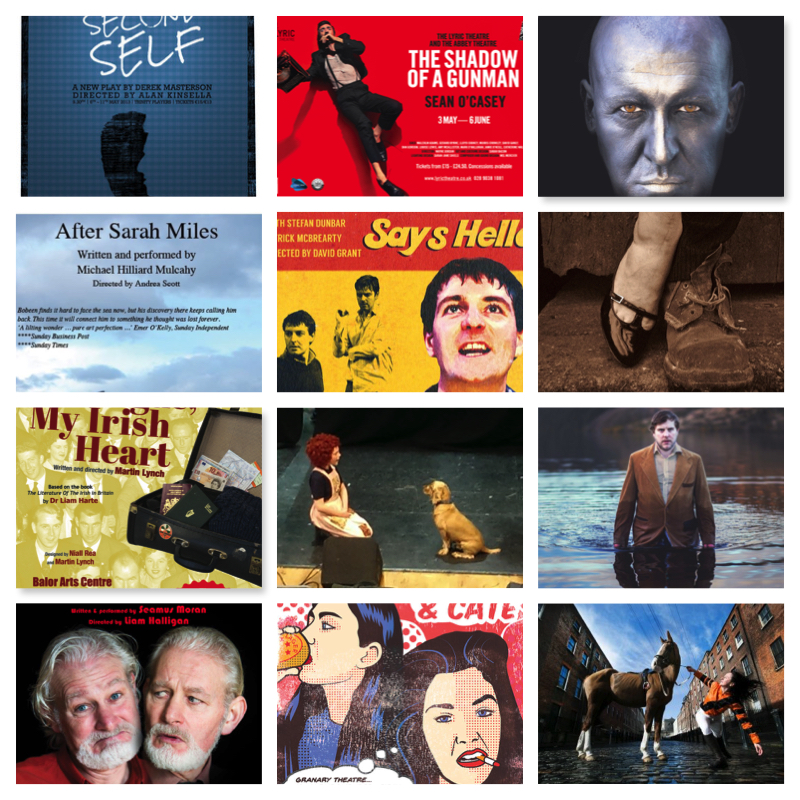
Several Young Critics went to see Mikel Murfi’s sublime The Man In The Woman’s Shoes, and Pat Kinevane’s equally sublime Underneath.

Michael Hillard Mulcahy’s After Sarah Miles, set in Dingle, was attend by Dusigh’s Young Critic from Tralee.

The two Young Critics from Footsteps Youth Theatre attended Seamus Moran’s Have a Heart at the Friars Gate Theatre Kilmallock, Co.Limerick.

There were also plenty of full productions on offer including An Grianan’s touring production of Frank Pig Says Hello by Pat McCabe and Martin Lynch’s My English Tongue, My Irish Heart.

There were World Premieres aplenty with Co. Carlow Youth Theatre members being treated to Jockey by Willfredd Theatre Co at Visual, Carlow.

Before Monsters Were Made by Ross Dungan was another World Premiere at Project Arts Centre as was My Second Self at the Civic Theatre and The Ballad of Charlie & Cate at the Cork Midsummer Festival.

Our Young Critic from Donegal Youth Theatre attended Annie The Musical at The Balor Theatre.

Finally Niamh Murphy, one of our Young Critics from County Wexford Youth Theatre attended Sean O’Casey’s The Shadow of A Gunman at the Abbey Theatre in Dublin.

Here is her very fine video blog review of the production.

Have you seen the show?

Would you agree with Niamh?

Heartbreak House – A Review by NAYD’S Young Critics

In the run up to NAYD’s Young Critics Panel on Oct 5th as part of the Dublin Theatre Festival, we continue to publish a series of reviews from the Young Critics.

Over the summer months,we asked the Young Critics to attend some shows on their own. We asked them to make a short vlog review of their experience. We then asked a selection of them to turn these into written reviews. Dr. Karen Fricker offered some editorial advice.

So with less than a week to go to the Young Critic’s Panel, Catriona Quigley reviews Heartbreak House 

Heartbreak House by George Bernard Shaw, directed by Roisin McBrinn

Performed by Lisa Dwyer Hogg, Nick Dunning, Kathy Kiera Clarke, Brendan Conroy, Marcus Lamb, Mark Lambert, Aislin McGuckin, Chris McHallem, Don Wycherley, and Barbara Brennan

Sets by Alyson Cummins, lighting by Paul Keogan, Costumes by Niamh Lunny, music and sound design by Philip Stewart

Viewed on August 21st 2014 at the Abbey Theatre

Reviewed by Caitriona Quigley

Heartbreak House: the name seems to imply anything but good-naturedness. At the same time, though, period dramas bring guilty pleasure for many, particularly now that Downton Abbey is so popular. And I’ve never studied George Bernard Shaw at all. Given all this, it was hard to know what to expect from the Abbey’s production – but I found myself sitting transfixed.

Shaw set his scene in 1914, just before the outbreak of the First World War, ensuring a plenitude of satirical jabs at the expense of the affluent upper classes who confined themselves to their trivial problems as the world changed around them.


Mark Lambert (Captain Shotover), Aislín McGuckin (Lady Ariadne Utterword), Kathy Kiera Clarke (Hesione Hushabye), Lisa Dwyer Hogg (Ellie Dunn) and Nick Dunning (Hector Hushabye) in Heartbreak House by Bernard Shaw, directed by Róisín McBrinn. Photo by Sarah Doyle.

Mark Lambert (Captain Shotover), Aislín McGuckin (Lady Ariadne Utterword), Kathy Kiera Clarke (Hesione Hushabye), Lisa Dwyer Hogg (Ellie Dunn) and Nick Dunning (Hector Hushabye) in Heartbreak House by Bernard Shaw, directed by Róisín McBrinn. Photo by Sarah Doyle.

The play concerns a colourful cast of characters who congregate for a country weekend at the dwelling of the surly yet outspoken Captain Shotover, played with appropriate gusto by Mark Lambert. Shotover has been estranged from his younger daughter Ariadne (Aislin McGuckin) for 23 years — yet she seethes when both the Captain and her eccentric sister Hesione (Kathy Keira Clarke) fail to recognize her. Hesione, meanwhile, has invited her friend, Ellie Dunn (the excellent Lisa Dwyer Hogg) to stay for the weekend. When Ellie arrives with her father and her fiancé in tow, she reveals that she’s had her head turned by a mysterious man, who as it transpires, may be a little too familiar to some of the guests…

I admired how Shaw deconstructs various archetypes often found in period dramas, such as the naïve young maiden, the crotchety patriarch, and the well-meaning best friend. The play’s central theme is deceit, and no character ended up to be as they appeared at the play’s outset. The characters and the audience are simultaneously strung along by this deceit, which paves the way for a literally explosive conclusion!


Aislín McGuckin (Lady Ariadne Utterword), Nick Dunning (Hector Hushabye) and Mark Lambert (Captain Shotover) in Heartbreak House by Bernard Shaw, directed by Róisín McBrinn. Photo by Sarah Doyle.

Aislín McGuckin (Lady Ariadne Utterword), Nick Dunning (Hector Hushabye) and Mark Lambert (Captain Shotover) in Heartbreak House by Bernard Shaw, directed by Róisín McBrinn. Photo by Sarah Doyle.

Heartbreak House, is, at times, an incredibly complex production to follow. I can’t count how many times my mum and I exchanged expressions of confusion about how the plot swerved in many directions, often with no prior warning. Yet, the dazzling set by Alyson Cummins, the actors’ impeccable comic timing and exquisite costumes by Niamh Lunny ensure that this production is, at its best, a genuinely enticing piece of theatre.

In conclusion, we found that Shaw’s razor-sharp wit and jovial banter made for insightful and pleasant viewing. Very highly recommended!

Catriona Quigley is a member of M.A.D Youth Theatre, Dundalk and an NAYD Young Critic for 2014

Put that in your notebook- I,Malvolio

I, Malvolio  written and performed by Tim Crouch
Peacock Theatre, Dublin
9 March 2013
Review by Michael Mc Grath

As the 19 members of our group (16 young critics and the facilitators Alan, Karen, and Diane [they’re also critics – we’re all critics!]) piled through the door of the Abbey’s Peacock Theatre, our expectant gazes were met with an accusing glower. It came from a figure dressed in excrement-stained pajamas dotted with flies, and bright yellow stockings, standing in a sparsely decorated set.

Image

Tim Crouch in I, Malvolio
Marcus Yam for The New York Times

Variations of these actions; our engagement and Malvolio’s judging looks were repeated over and over, and we were also soon met with his accusing words. The routine was denied the chance to stagnate by the increasing brutality of our relationship with one another, culminating in the arrival of a noose. An hour later we left our seats feeling a bit puzzled after Malvolio’s subtly-delivered “revenge,” a surprise that we are promised from the start, a punishment for our casual sins. Puzzled and intimidated but also intrigued and impressed. This I won’t spoil for you on the off chance that you are ever given the chance to see Tim Crouch’s brilliant I, Malvolio.
This is a one-man play told from the perspective of Shakespeare’s Malvolio, locked in his prison after the curtains have drawn on Twelfth Night. He is eager to have his say as he peers down on his squirming audience, and often orders us up to the stage to stand with him under the spotlight, literally and figuratively, in this clever performance.

“I am not mad,” Malvolio insists to his audience, whom he regards with contempt but who he believes need to respect his sanity. “Put that in your notebook” he spits at us after noticing our hasty scribbling. This is a taste of Crouch’s witty improvisation which dots I, Malvolio and provokes the most laughs in response to the play.

Soon after “mounting the horse of the script” — as the wonderfully strange half-Malvolio, half-Crouch puts it — we are told exactly how Malvolio intends this “well, whatever ‘this’ is” to go: he will first make us laugh and then attack us for laughing. This is the root of I, Malvolio, which brings the human cruelty inherent in comedy out in the open, where it both causes and silences our laughter with constantly changing tides of glee and guilt.

© Michael Mc Grath 2013

Leaving an Imprint

Rian

Fabulous Beast / Liam Ó Maonlaí / Michael Keegan-Dolan

Cork Opera House

Reviewed 22 June 2012 by Sarah Brett, Niamh McCormack, Sarah McGooghan, Megan Moroney, and Aaron Mullaney

Rian as gaeilge translates as ‘imprint’. Inspired by Sean O’Riada (one of the most influential icons in the mid-20th century revival of Irish traditional music), Liam Ó Maonlaí ‘s music inspires powerful and emotional movement from both the cast of contemporary dancers, and, at the show’s end, the audience. The experience is unique and awakens the primal imprint of rhythm and joy within us. Along with O’Maonlai, Michael Keegan-Dolan, artistic director of Fabulous Beast Dance Theatre, has created a beautiful, passionate and moving ensemble of music and dance.

The technical abilities of both the dancers and musicians are evident throughout the performance. The organic beat of the dancers’ bare feet on the floor reinforced that of the bodhrán, combining to create an electric atmosphere. Although at times the dancers are not directly in sync with each other, the contemporary movement offers a context for this. Rian is a traditional Irish music lover’s paradise but the tribal beats and foreign and modern influences mean it is not exclusively so.

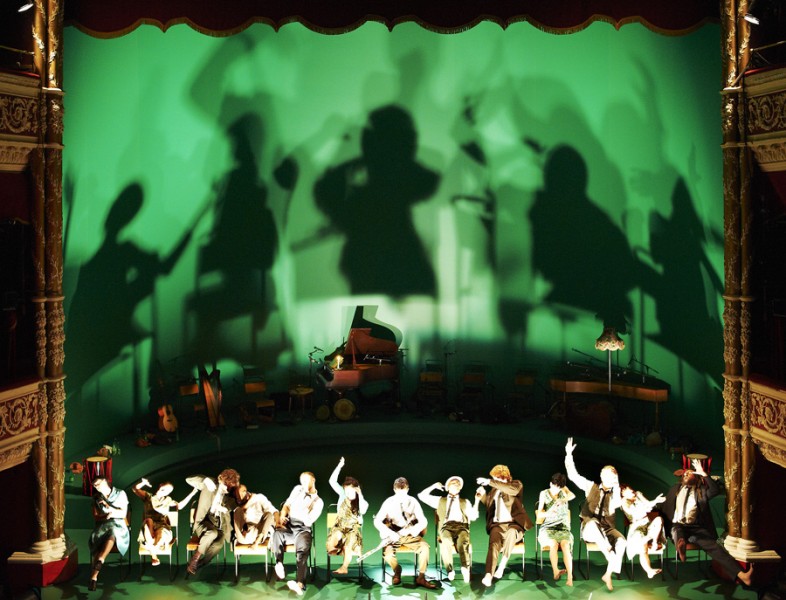
The stage layout was very striking as eerie shadows cast upon the light green backdrop helped create a feel of nature throughout the show – like how fire casts shadows upon the earth around it. Also the traditional semi-circular layout of the musicians and dancers worked well, as the audience felt as though they were taking part in a real Irish session.

There were certain aspects of the performance, however, that felt somewhat obvious and perhaps stereotypical. The nature of the stage layout made it difficult to see the whole performance at times; and there were some musical faux pas in terms of harmony. The ending of the performance was somewhat misleading as after the cast took their bow the show continued on, which was fortunate as the audience was then asked to come up on stage and dance with the cast. As minor as these flaws were, they were trifling compared to the overall performance of this outstanding show.

Rian gives a beautiful impression of the Irish culture and spirit. The performance offers an open and inclusive look into the Irish community. The dancers’ vivacious performance created an excitement in the audience and throughout the performance you had to suppress the urge to jump on stage and join the dancers. At the end, we finally were given this chance! Overall, this performance left an imprint on its audience and we highly recommend you to go and see it.

Image

A Matter of Record

Record

Dylan Tighe
Half Moon Theatre
Reviewed 23 June 2012

by Sadhbh Keating,Amaka Attoh,Kim Molloy,Eimear Deery

Record by Dylan Tighe is an extremely difficult performance to critique as it is an autobiographical, emotional play about Tighe’s struggle with bipolar disorder. Also, we must note that we saw only the second preview and the production may change, and grow.

The setting is, for the most part, drab. The pre-set is very intimate; it feels like Tighe’s personal space. Guitars, a drum set, a large writing desk and a leather chair all dressed in dark colours reflect the melancholic mood of the show.

Tighe uses music from his debut album Record, his own medical records, and multimedia to portray the concept of mental illness. Tighe takes on the role of himself which provides authenticity and real raw human emotion. This also highlights the isolating and internalised nature of this disease. Keeping with the intimate nature of the performance, the supporting cast of musicians and actors is very small. Aofie Duffin takes on the role of Tighe’s nurse and love interest but, unfortunately, her performance lacks credibility. A more positive point of Duffin’s performance is her singing voice. Her hauntingly beautiful voice captures the turmoil of emotions her acting didn’t. Daniel Reardon takes on the role of the austere doctor and gives a satisfactory performance.  Despite the small cast of supporting actors and their inability to effectively portray the story, powerful messages still come through, one being that medication may not always be effective to treat mental illness.

Elements such as Tighe’s own music also reinforced these messages and provided clarity to some of the more obscure images. Custom-made films about Tighe’s life and his ideas show his confusion and loneliness when in a depressed state, which gives the show a sense of reality. Tighe must be commended for this fearless production as he puts everything on the table.

Although the production deals with dark matters, humour and live music give it an uplift. We recommend it, although during parts of the show fantasy and reality collide, leading to confusion and ambiguity. This mirrors Tighe’s state of mind at the particular point in his life, and leaves the audience with much to contemplate.


Cork Midsummer Festival – From a Young Critic

I can honestly say that the weekend I spent with Young Critics at the
Cork Midsummer Festival was one the best of my young life so far. I was challenged by all four of the productions we attended to go outside my comfort zone physically and mentally. I was left thinking deeply about things such as mental health, what is means to be Irish, the materialistic values of today and lives that dwell behind closed doors.


My weekend began with a bus trip for me to ponder over what was ahead. I was excited and glad to be meeting my fellow young critics again. Together again for the first time in two months, we headed with Alan,Diane and Mirjana to our accommodation Victoria Lodge at UCC. Waiting for us there were welcome packages from the kind people of Cork Midsummer Festival, as well as complimentary food!

Image


After being fed and watered, we trundled along to the Camden Palace Hotel, a quirky arts centre where we met up with Karen Fricker and took part in a workshop about the piece we were to see that night –Fabulous Beast’s Rian. This workshop was substantially more physical than previous ones; we explored the idea of abstract expression through movement. We discussed what Irish music meant to us all, our concepts of dance and watched an introductory film about Rian. We were truly pepped up at this point for a spectacular performance – and that it was.

Rian was one of the best performances I have ever witnessed. There was such a natural energy onstage, and the performers showed nothing but absolute joy in every single movement they made. Traditional Irish music and contemporary dance are not two things I have ever shown much interest in, nor did I ever think they could have meshed so well together! Liam Ó Maonlaí did Séan Ó Riada proud, amalgamating music of all cultures with traditional Irish. I was struck with a great sense of beauty at this magical performance, and the simplicity of human movement. To make a wonderful night even more so, the audience was invited onstage to share in the fabulous art of dance and we were joined by the director Michael Keegan-Dolan. It was a night that will stay in my memory for a long time.

Home we came to Victoria Lodge, still buzzing but in desperate need of sleep, some of us being up since as early as 06:00am. The next morning was an early one, and we trekked to Cork School of Music for the second workshop of the weekend to discuss our thoughts about Rian. We then turned our focus to the Parallel Cities project and to Dylan Tighe’s production of Record, and created some ideas as to what we were expecting.

Parallel Cities was a new experience for us all – Shopping Centre was an immersive performance, in which we took a set of headphones and a pocket radio and were instructed on how to act in a particular shopping centre in Cork (location top secret). It was great fun acting as an agent of the underground, but there was also a clear message in this piece: that consumerism and materialism has taken a hold of modern life, and that we are becoming slaves to our relationships with items rather than with people.

The other Parallel Cities piece we ‘saw’ was House, which gave a look into true life stories of various people living in Cork at the moment. I enjoyed the simplicity of this piece; we stood with headphones outside a house and observed the lives inside. The piece took me out of my own mind and reminded me of the importance of everyone’s story.

Between these two pieces we went to see a preview of Dylan Tighe’s Record. This play really struck a chord with me, if you will excuse the pun. The truth of Tighe’s life is literally laid bare for the audience to see in this piece, as he delves into his struggle with mental illness and the Irish health system. There was a complete connection made between man and audience through his heartfelt music and lyrics. Record made me think a lot about the complexity (and often the torture) of life, and this was succeeded through satirical humour as well as tragedy. Despite the pain and suffering, hope was the last note sounded in the play. The necessity of the ability to love dominates the message board of Record’ and I know will never listen to Fleetwood Mac’s ‘Need Your Love So Bad’ without thinking of Dylan Tighe.

The morning of the 24th was another early one in Cork School of Music again for our final workshop. We split off into smaller groups and were given the challenge of composing a review of one of the four pieces in just 40 minutes. It was such a thrill getting our reviews in on our first real deadline, and we were sixteen happy young critics that afternoon! We travelled to the bus and train stations and said our goodbyes, promising to keep in contact and keep critiquing.

As great as I thought the first weekend in Dublin was, Cork was twice that. It is really such a beautiful city, and the artistic opportunities available are enough to tempt me to move there! I loved the raw honesty I found in every one of the productions we went to see, and I cannot thank NAYD and Cork Midsummer Festival for giving me this invaluable experience. I feel myself coming away from Young Critics enriched with different tastes of theatre, and with an unending appetite for more.

Madi O’ Carroll, County Wexford Youth Theatre

Welcome to the Desert of the Real

Parallel Cities:Shopping Centre: The First International of Shopping Malls

Linga (Hamburg/Berlin)Image

Undisclosed mall location, Cork

Reviewed on 23 June 2012 by Caroline Allen, Robert Galvin, Art Kellegher, Aoife Lanigan, and Madi O’Carroll

Parallel Cities:Shopping Centre: The First International of Shopping Malls was like drawing your head out of the Matrix and taking a real look at the world around you. In the past, the production company Ligna have put together a number of immersive performances. The audience listen through headphones and are directed by a pre-recorded set of instructions.

It would be a shame to live in Cork and not experience this show. Whether you consider yourself an extravert or an introvert, this treasure hunt (for a treasure you’re not supposed to want) will challenge you to step outside your comfort zone. It’s likely everyone will experience something different – from your first reaction to the shopping centre to your final impression as you walk out the shopping centre door.

From the word go, we’re invited to observe the shopping centre from the position of an outside agent, and see the world of commodities for what it really is. The instructions initially seemed to have no meaning, but as the performance progressed the anti-consumerist message became clearer, as we were invited to become seceret agents in an underground movement. As the shopping centre speaks, both metaphorically and literally, we finally become aware of the monontony of consumer culture.

The experience was somewhat bizarre, as it challenges our perception of everyday life, as well as asking what can be considered performance. It asks questions about the choices we make and are made for us.

The question that this piece leaves us with: is this really theatre? We found the line between reality and drama blurred, joining the audience and the performance as one. Without this division, it is somewhat unclear as to what we felt leaving the shopping centre.

A thought-provoking, captivating and sometimes uncomfortable production, this piece from the Parallel Cities project was quite unforgettable. An extraordinary vision of ordinary life was presented to us all, challenging us to reconsider modern life as we know it.

Parallel Cities is presented as part of Cork Midsummer Festival

http://www.corkmidsummer.com/