Wishful Beginnings Reviewed by NAYD Young Critic Emily McGee

The NAYD Young Critics came to Dublin from the 7th – 9th of October for the Dublin Theatre Festival. They attend three productions as part of the Festival. Here Young Critic Emily McGee reviews Verk Produksjoner’s Wishful Beginnings at Project Arts Centre.

beatthedrum-img-7236-ie-1536x1024

Wishful Beginnings . Photo Credit: http://verkproduksjoner.no/

Wishful Beginnings

Wishful Beginnings: undoubtedly a show with the power to start the revolution that our world today needs most.

Upon entering the theatre of the Project Arts Centre on the 7th of October 2016, the audience suddenly, with or without realising, became immersed in the concept that Verk Produksjoner placed before us. The first thing that you can’t help but notice is the towering plywood wall reaching from the floor upwards, seemingly with no end. This wall was placed at the front of the stage, leaving the actors with a stage approximately no more than two metres in width. Seemingly random costume and prop items lined the outer aisles, where the actors waited to begin.

Between the towering wall of the set, and being entirely surrounded by five actors in various stages of curious costumes, to an extent, the audience couldn’t help but feel somewhat enclosed within the space. This made a very bold and effective addition to the performance as it really aided in exposing the concept of the piece.

Wishful Beginnings is not your traditional piece of theatre, but that’s precisely what I loved most about it. It was more of a conceptual, contemporary, abstract piece of theatre. It took an in-depth look at our world and our society at this present moment in time, and explored through means of improvisation and symbolic or metaphorical scenes, what our future will look like if we continue as we are.

Verk Produksjoner touch on topics such as; fashion and popular culture, mental health and self-harm, industrialisation, LGBTQ+ rights, and animal cruelty. These topics were approached in a rather artful way by using metaphors and symbolism, truly advocating the “show, don’t tell” technique. However, as this technique was so well put to use that, on the surface, it almost seemed as though none of these topics were covered. It was only when the symbolism (ranging from the use of costume, prop, script, and lighting tools) became fully understood, did these topics, or “social issues” and the concept of the piece, become the plot.


img_7282-e1460126962746-1080x600

Wishful Beginnings. Photo Credit: http://verkproduksjoner.no/

The acting from all of the actors was to a very high standard. It was very natural and credible. Espen Klouman Hoiner, in one scene in particular, gave an outstanding, powerful and moving performance portraying a painful death. The performances overall were very impressive, especially so when taking into account that parts of the show were improvised. Despite this, the show flowed seamlessly, the improvised scenes becoming almost indistinguishable from the rehearsed, adding to the authenticity of the entire production.

Overall, Wishful Beginnings was a thoroughly enjoyable experience. It was truly a powerful and moving artwork. However, as enjoyable and powerful as I found it to be, I understand that this show is not suited to everybody, as it may be difficult for some to fully grasp the concept, and therefore, the “plot” of the piece. Wishful Beginnings is most definitely a show that I’m glad not to have missed.

Cast and Creative Team: 

With and by Fredrik Hannestad, Saila Hyttinen, Tilo Hahn,  Signe Becker, Solveig Laland Mohn,  Håkon Mathias Vassvik, Per Platou,  Anders Mossling, Espen Klouman  Høiner, Pernille Mogensen,  Camilla Eeg-Tverbakk,  Jon Refsdal Moe, Agnes Gry

Project Arts Centre  as part of Dublin Theatre Festival

Co-production by Black Box TeaterBIT-Teatergarasjen and Teaterhuset Avant Garden.

Emily McGee was a Young Critic for 2016 and a member of Kilkenny Youth Theatre 

Review of The State Of The Nation by NAYD Young Critic Rita Havlin

In the run up to the Young Critics Panel as part of the Dublin Theatre Festival on Oct 9th, we’ve been publishing a series of written reviews by our Young Critics.

In our final review, Rita Havlin from Donegal Youth Theatre reviews The State Of The Nation by Conor Malone

Reviewed 4 June, 2016
Written by Conor Malone, directed by Charlie Bonner
Balor Developmental Community Arts
Balor Arts Centre, Co. Donegal

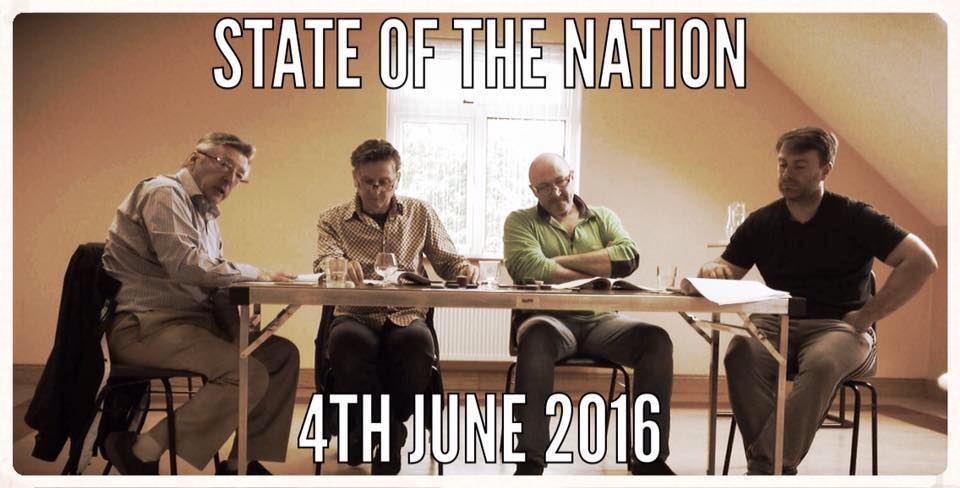
The State Of The Nation is a political satire questioning Ireland’s progress since the 1916 Rising. The play is set during a poker game in the afterlife, during which four famous figures of Irish politics, Thomas Davies (James Lawne), Jim Larkin (Peter Byrne), Michael Collins (Cillian O’Gairbhí), and Charlie Haughey (Conal Gallen), discuss the changes in the country over the last hundred years and the issues it still faces. I found this to be a very interesting way to frame this debate, literally asking “Is this the Ireland the revolutionaries dreamed of?”

A simple set design helps the audience focus on the content of the play. The action takes place on a raised white platform around a large table; a hat stand and a sideboard with decanters of whiskey stand at either end of the platform. Dim lighting and smoke set the scene for a classic game of poker, while a green backlight gives a supernal feel. This worked extremely well in balancing the realistic with the non-naturalistic.

7-all-the-cast-in-reheasal

Conal Gallen, James Lawne, Peter Byrne, Cillian O’Gairbhi in rehearsals for The State Of The Nation. Photo Credit: Mark Fearon

The actors did a superb job in balancing the speech and mannerisms of different points in history, making no word or action feel out of place while also managing to maintain realistic and strongly recognizable characters. Their only downfall, which was perhaps a fault of the play itself, was a lack of movement, as the actors only left the table to refill their whiskey.

Indeed the writing is where The State of the Nation falls short. The play is meant to be comedic, and while no lines fall completely flat and some earn a hearty laugh from the audience, many jokes are overused or too similar to previous ones, and quickly lose their punch. The play touches on many important issues such as government salaries and corruption, the introduction of water charges, and the cost of education, but brought up in such a short space of time each issue begins to sound the same and each discussion seems half-baked. There is no suggested solution for any issue, and so no debate feels complete before the play moves on to a new topic.

2-the-state-of-the-nation

Poster design by Alan Reid

Staged as part of the Donegal County Council’s 1916 Commemoration, the play aims to celebrate Ireland as the country grows and develops, which it does to a degree, but it felt a little too critical of the nation to do this fully. The play fails to address the rich culture and art that Ireland has to offer, or the ways in which Ireland has progressed farther than many countries, focusing instead on the country’s political failings. However I must compliment the cast and crew as this production, despite its weaknesses, left me feeling satisfied, appropriately patriotic, and chuckling as I left the theatre.

Come join Rita and all our Young Critics on October 9th at 1pm at Project Arts Centre. 

They will be critiquing three productions as part of Dublin Theatre Festival 2016. 

Shakespeare’s Globe Taming Of The Shrew. Reviewed by NAYD Young Critic Pierce McNee

In the latest in our series of Young Critics reviews, Pierce McNee from Dundalk Youth Theatre traveled to London to see The Taming of the Shrew at Shakespeare’s Globe.

The Taming of the Shrew by William Shakespeare, directed by Caroline Byrne

Cast: Aoife Duffin, Amy Conroy, Louis Dempsey, Imogen Doel, Colm Gormley, Aaron Heffernan, Genevieve Hulme-Beaman, Raymond Keane, Gary Lilburn, Edward MacLiam and Helen Norton

Performed at Shakespeare’s Globe; reviewed on Monday, 18th July 2016

Taming of Shrew SECOND-814.jpg_captioned.jpg

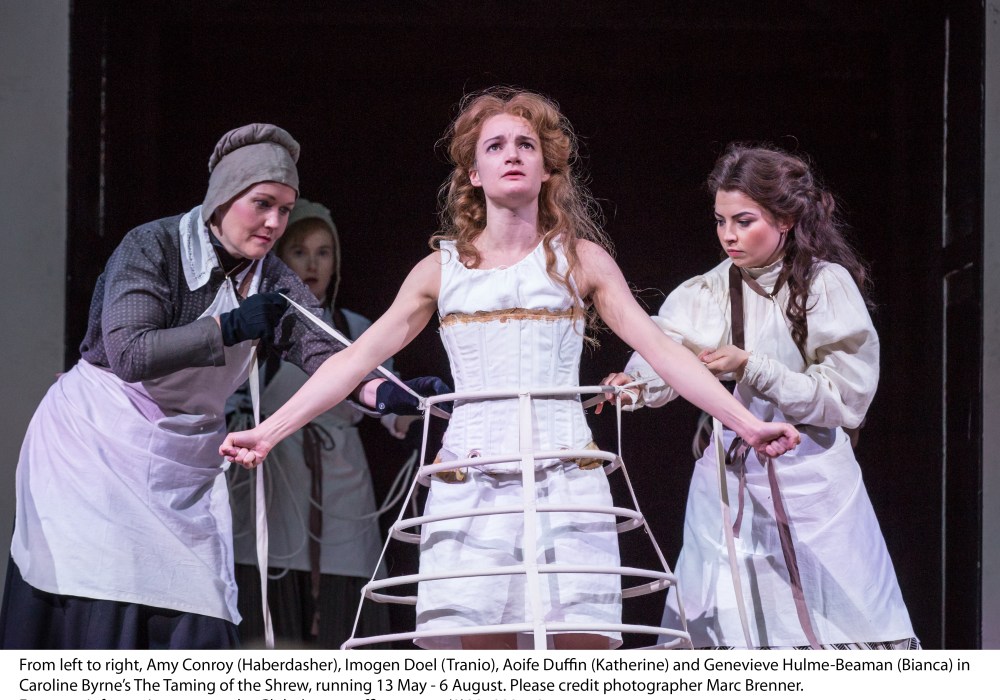
Set against the backdrop of Dublin 1916, this is a classic play with an alternative twist, featuring an all-Irish cast. This choice of setting — one hundred years after the events that sparked Ireland’s drive towards independence — makes the staging of this production extremely significant. Katherine (Aoife Duffin) appears on the stage at the start of play and sings, passionately, an Irish ballad written by Morna Regan (dramaturg and lyricist) especially for the production. This firmly establishes the 1916 setting and showcases Duffin as a standout performer and a force to be reckoned with.

The Taming of the Shrew tells the story of two sisters, Katherine and Bianca. Bianca is intensely keen on being married off to a handsome suitor. Katherine has no ambitions to become attached to a man. There is one problem: Bianca cannot marry before Katherine, a.k.a. the shrew, is herself paired off.

Taming of Shrew SECOND-309.jpg_captioned.jpg

Going in, I was rather sceptical as to whether or not the production would cater for only an Irish audience, but it does not overly enforce the 1916 theme, which only becomes apparent on a few occasions. For example, a small fraction of the history is played out in the lyrics of Katherine’s two ballads. This make the theme subtly present throughout the performance but the production is kept grounded overall in the original story.

Caroline Byrne’s production is full of side-splitting antics whilst still exposing the serious and sometimes poignant aspects of the play. The misogynistic elements are portrayed with the earnest tone they deserve. The comedic facet is aided in particular by Aaron Heffernan as Lucentio, with his incredible physical comedy and natural wittiness.

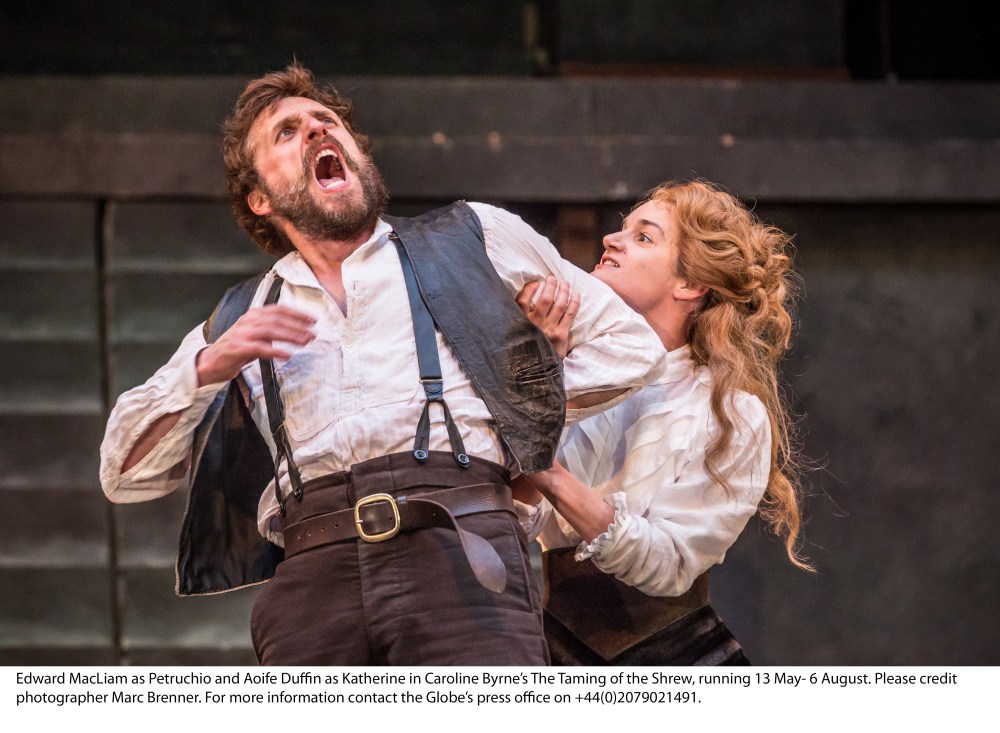
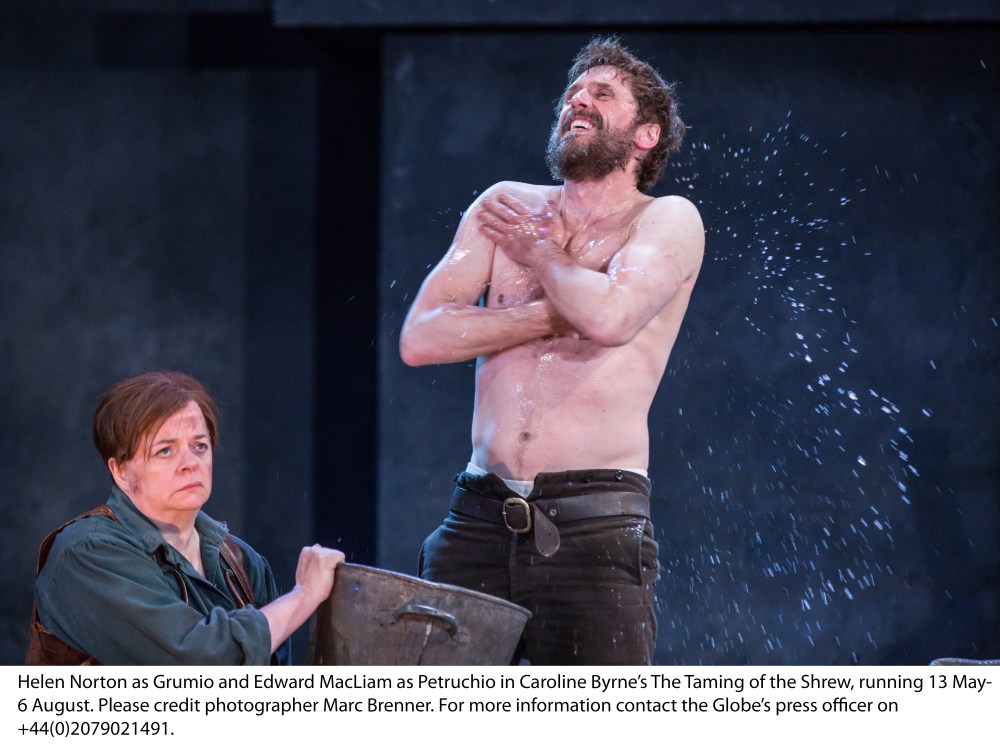
Other notable performances include Edward MacLiam as Petruchio, who offers a truly gritty portrayal of the character. He brings an amazing sense of tension with Katherine and this really keeps the audience on the edge of their seats for the intense scenes between them. Helen Norton as Grumio plays her character with great jocularity but also sincerity in the more sombre scenes.

Taming of Shrew SECOND-412.jpg_captioned.jpg

The set, designed by Chiara Stephenson, starts with the traditional Globe stage design with its balcony and pillars. A large black structure is built into the opening at the upstage centre of the stage. This opens up at various points to reveal a staircase. At certain moments during the first half, the stage becomes a 1916 classroom as a prodigious abacus and an anatomical skeleton hurtle onto the stage. A pit of dirty water also appears at the downstage centre of the stage in which Katherine stands while singing one of her ballads.

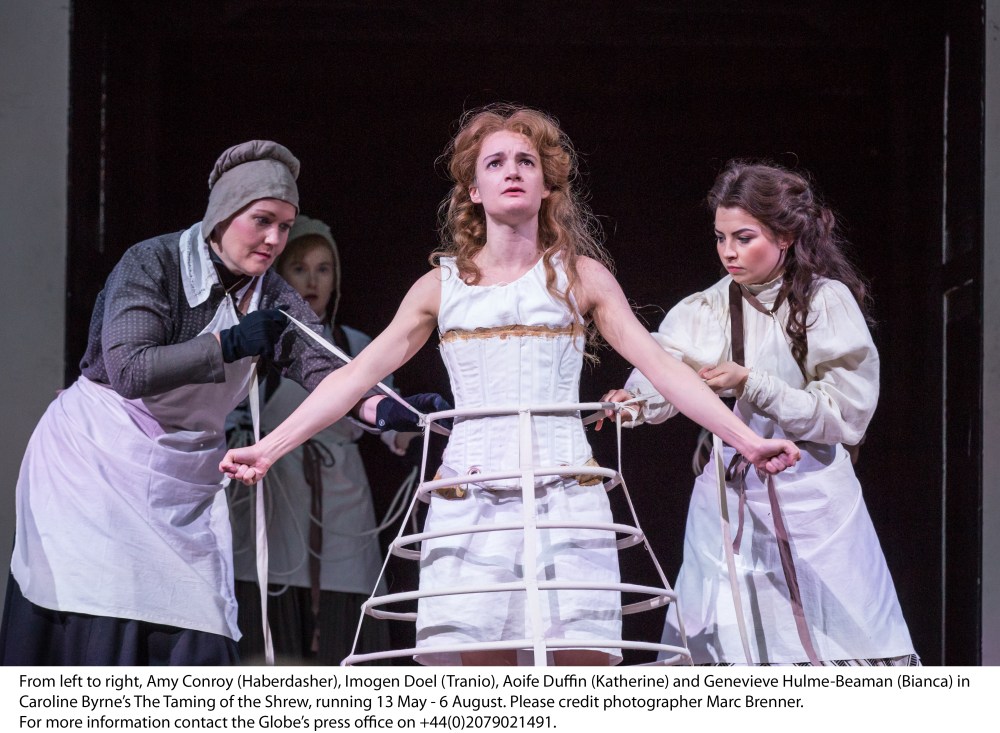
The costumes, also in Stephenson’s more than capable hands, are eminently satisfactory and greatly fitting to the production. Many of the costumes are 1916-inspired with the women’s pieces heavily influenced by the Gibson Girl look. This also introduces the theme of women’s rights one hundred years ago and also in today’s society. The final speech, delivered by Katherine, allows us to reflect on how much has changed in terms of women’s rights since 1916, when women were so poorly treated.

Pierce is an NAYD Young Critic for 2016 and a member of Dundalk Youth Theatre in Co. Louth.

Come join Pierce and all our Young Critics on October 9th at 1pm at Project Arts Centre.  They will be critiquing three productions as part of Dublin Theatre Festival 2016. 


Invitation to a Journey. Reviewed by NAYD Young Critic Ciara Lummis

Invitation to a Journey

CoisCéim, Fishamble, Crash Ensemble & Galway International Arts Festival

Project Arts Centre, Temple Bar

Reviewed on 21 July 2016

€22 million – the figure Eileen Gray’s Dragon Chair sold for in 2009. That’s all most people know about her. This production uncovers a great deal more than this fact, exploring the personal encounters in Gray’s life and sharing the accomplishments of this Irish artist with the Irish public.

Invitation to a Journey explores Gray’s life in vivid detail, from her colourful relationship with Damia, her French lover (portrayed powerfully by Kate Brennan), to her innovative career as an architect and designer. It is a co-production of Fishamble: The New Play Company, CoisCéim Dance Theatre, the contemporary music group Crash Ensemble and Galway International Arts Festival, and is written and performed in a groundbreaking way. The roles of the three dancers, three actors, and four musicians are melded to the extent that in some scenes it is difficult to tell them apart, especially in one scene where Damia and the dancers fight over a chair, all essentially becoming dancers.

Unknown.jpeg

Invitation to a Journey. Photo: Ros Kavanagh


The musicians wear costumes suited to the era and have their hair crimped in a ‘20s style, which connects them to the dancers in particular, as they have the same hairstyle. (In the interest of full disclosure, I will say that my mother Deirdre O’Leary was involved in this production as one of the musicians).

The show opens with the three dancers offering their interpretation of Gray’s architecture through movement. Half a dozen nine-foot-tall doors on either side of the stage are then flung open by the remaining cast members, which segues into the auction of the dragon chair. As the cast bid for the chair, Ingrid Craigie — the actor playing Eileen Gray — sits in a chair behind them and becomes fleetingly visible as the bidders exit the stage and the lights dim. Her presence becomes much stronger as the show progresses, although at times that presence is overshadowed by the sheer amount of things going on onstage.

Halfway through, the show enacts the construction of e.1027, the iconic house Gray designed for herself and her lover the Romanian architect Jean Badovici. String outlining the foundations is taped to the stage by one of the dancers as Gray struts around the stage carrying blueprints. Only shortly afterwards, Le Corbusier (played by Ronan Leahy) paints lewd murals on the pristine walls of e.1027, nude.

Project-Poster-e1469445361381.png

In an era when most women were married off, Eileen Gray was openly bisexual, almost insanely driven, and creative. She was modern when it wasn’t mainstream and this show echoes that crazy creative determination that possessed her. While this show ambitiously melds the roles of dancer, actor and musician, it would be interesting to see what the difference in dynamic would be if the musicians had more dialogue with the rest of the cast and if Gray was more involved in scenes with the dancers. The mixture of concrete and abstract information presented through the different art forms gave a strong impression of someone’s personality. It seemed to be trying to express an inner creativity and drive that I now associate with Eileen Gray.


NAYD Young Critics 2016.jpg

Ciara is an NAYD Young Critic for 2016 and a member of Fracture/ Play Youth Theatre in Tipperary

Come join Ciara and all our Young Critics on October 9th at 1pm at Project Arts Centre.  They will be critiquing three productions as part of Dublin Theatre Festival 2016. 

Radiohead – An NAYD Young Critic’s Review of Glitch. Review by Louis Flanagan

As the Young Critics hit the stage of the Dublin Theatre Festival  on Oct 9th , we will publishing a series of written reviews from our Young Critics.  

In the first of our reviews Louis Flanagan from Droichead Youth Theatre reviews  Calipo Theatre Company’s production of Glitch by Martin Maguire

Glitch by Martin Maguire

Produced by Calipo Theatre Co.

Directed by Darren Thornton

Cast: Martin Maguire & Grainne Rafferty

Droichead Arts Centre

June 22nd- 24th  2016

Calipo Theatre Company’s return to theatreland has been a long time coming. Nearly five years after the success of Pineapple by Philip McMahon at the 2011 Drogheda Arts Festival, the troupe recently pounced back on our stages with a fresh and authentic piece of work called Glitch.

Time may have passed but the Calipo team remains as strong as ever, with director Darren Thornton – currently in the spotlight for his acclaimed feature film A Date For Mad Maryand writer/performer Martin Maguire reigniting a theatre partnership that stretches back almost twenty years.

Glitch has a simple plot – it follows the story of broadcaster Mike Adams (Maguire), whose drivetime radio show has dominated the landscape for nearly fifteen years but whose popularity is diminishing. Everything appears to be changing – the politics, the technology, the public opinion. The media has become increasingly fast-paced and suffocating and Mike is under fierce pressure to change as well.

Constantly in denial and trying to escape his commitments, Mike is faced with a crisis when Jesse (Grainne Rafferty) emerges – a bitter and stubborn caller, who ends up alone on the air with Adams, following a technical glitch. For rest of the piece, we see Mike and Jesse engage in a battle of wits. Amazingly, these two characters never come face-to-face, which Jesse positioning her battle station behind Maguire, which spends most of the performance downstage.

On paper, Glitch does not make a striking impression. However, this production was not only executed sharply but had an incredibly original and innovative design. Kieran McNulty’s set was spacious and vibrant, comprising of an orange desk and vertical fluorescent lights emerging from the polished, black floor.

glitch-2

Martin Maguire in Glitch. Photo Credit: Calipo Theatre Company

While the set was imposing and eye-catching, it was the sound design by Jack Cawley which made the greatest impression. Cawley successfully compiled over fifty voiceovers to create an array of different characters, from frustrated callers to newscasters to the people prominent in Mike’s life. Despite just two actors onstage, the flawlessly executed sound design created the illusion that there were many more.

Glitch is Maguire’s first play in nearly ten years. In fulfilling the challenging task of being both writer and performer, Maguire’s nerves were evidently visible onstage on the night I saw the show, and his delivery was sometimes unclear and unsteady. However, he maintained an excellent chemistry with Rafferty, who herself gave a robust and fiery performance as a single mother caught up in the struggles and prejudices of modern Ireland.

Tough on the surface, through lengthy and passionate conversations both Maguire and Rafferty’s characters’ softer, weaker sides are revealed. Both are isolated and have problems, and both have continuously disappointed the people in their lives. Through some particularly heartfelt monologues, we learn about Mike’s relationship with his elderly parents and his father’s final hours alive.

Overall, Glitch was a highly enjoyable production. Thornton’s ability to make the audience become invested and engrossed in Mike and Jesse’s strained lives demonstrates his excellence as a director.

Louis is an NAYD Young Critic for 2016 and a member of Droichead Youth Theatre 

Come join Louis and all our Young Critics on October 9th at 1pm at Project Arts Centre.  They will be critiquing three productions as part of Dublin Theatre Festival 2016. 

Conor McPherson’s The Weir – A Young Critics Video Review

As part of the NAYD Young Critics Programme 2016,  the Young Critics were tasked with seeing a production in their local venues and were then asked to create a critical response vlog. The Young Critics

They were encouraged to utilise their own programming eye and select work that they would then be able to create a critical response to. These critical responses take the form of  short video blog reviews or podcasts, where they discuss the shows.

Since the start of May, the Young Critics have been seeing work and then writing, shooting and editing their own individual critical response vlogs. Some of these take the form of straight up critical responses, while others utilise comedy, drama and other techniques to respond to the work.

Two of the Young Critics, Mary Condon O’Connor from Fracture/ Play Youth Theatre in Tipperary and Colm Maye from Activate Youth Theatre in Cork reviewed The Weir by Conor McPherson.

Presented by Decadent Theatre Company, the show toured Ireland in June 2016.

First up is Mary’s Review:

Watch this space where we will be uploading Colm’s review very soon.

Come join us on October 9th at the Project Cube, Dublin, where the Young Critics Panel will be critiquing three shows as part of the Dublin Theatre Festival 2016

Brokentalkers – The Blue Boy – A Critical Response by Jack Synott

As part of the NAYD Young Critics Programme 2016,  the Young Critics were tasked with seeing a production in their local venues and were then asked to create a critical response vlog.

Jack Synott from Droichead Youth Theatre saw Brokentalkers production of The Blue Boy at the Droichead Arts Centre as part of the Drogheda Arts Festival.

Watch Jack’s very insightful film here

Find out what NAYD Young Critics have been doing over the summer months.