The Risen People – Review

Saoirse Anton from Laois Youth Theatre went to a recent performance of The Risen People at the Abbey Theatre. This is her review.

I, like many others, studied the 1913 Strike and Lockout in school, I know the history of it, the facts, the figure, but never before has it been more alive in my mind than as I watched the Abbey Theatre’s production of  The Risen People by James Plunkett, directed by Jimmy Fay.

A moving and engaging piece of theatre, The Risen People brings the harsh reality of the lockout to life, reminds us of the day to day difficulties of the families involved and draws the audience into the world of Dublin in 1913.

Every aspect of the production added to the atmosphere and drew the audience further into the story. The incredible musical numbers, choreographed by Colin Dunne with music by Conor Linehan are, in my opinion, some of the best I have ever seen. Some serve to convey the raw suffering of the people, some show the dissatisfaction that sparked the rising and some, such as  The Internationale  serve to rouse the spirits of the audience and give them a taste of the pride and drive that led the workers to stand up for their rights.

The shadowy, cold lighting (Paul Keogan)  and sparse set (Alyson Cummins)  are beautifully designed to give the audience a sense of the poverty and hardship felt by the workers. These, when combined with the excellent acting performances, particularly by the female characters, played by Hilda Fay, Charlotte McCurry and Kate Stanley Brennan, make for a truly breathtaking production.

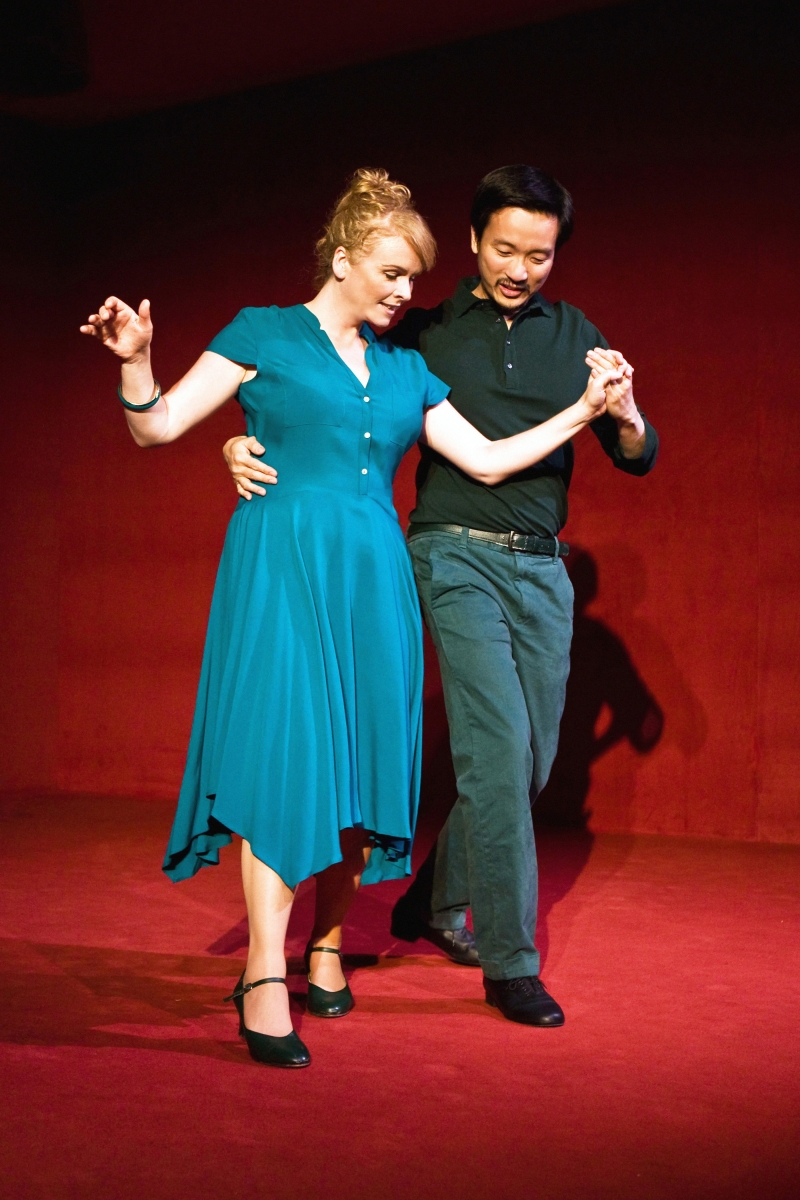
L-R Phelim Drew (Mr. Hennessy), Joe Hanley (Rashers Tierney), Keith Hanna (Pat), Kate Stanley Brennan (Lily Maxwell), Charlotte McCurry (Annie), Ian Lloyd Anderson (Fitzpatrick), Hilda Fay (Mrs. Hennessy), Lloyd Cooney (Joe), Simon Boyle (Keever / RIC Man), Conor Linehan (Piano / Ensemble) and Niwel Tsumbu (Guitar / Ensemble) in The Risen People by James Plunkett, adapted by Jimmy Fay from a version by Jim Sheridan. Photography by Ros Kavanagh.

L-R Phelim Drew (Mr. Hennessy), Joe Hanley (Rashers Tierney), Keith Hanna (Pat), Kate Stanley Brennan (Lily Maxwell), Charlotte McCurry (Annie), Ian Lloyd Anderson (Fitzpatrick), Hilda Fay (Mrs. Hennessy), Lloyd Cooney (Joe), Simon Boyle (Keever / RIC Man), Conor Linehan (Piano / Ensemble) and Niwel Tsumbu (Guitar / Ensemble) in The Risen People by James Plunkett, adapted by Jimmy Fay from a version by Jim Sheridan. Photography by Ros Kavanagh.

The cherry on top, which really brings the production into the here and now, is the Noble Call in which each night, a well known figure is invited to give their opinions on the production and share the message they gained from it through words, art or music.

I can promise you that from the striking opening sequence through the stirring story, as the houses are emptied and the pawn shop is filled, to the final line, your eyes will be riveted to the stage and you will feel every emotion of every character.

You will live the lockout.

The Risen People runs until Feb 1st 2014. For more information and booking details please visit The Abbey Theatre Website 
‘We sure ain’t in Cork anymore, Toto’ – The Young Critics Come to the Dublin Theatre Festival

Jess Richter from Lightbulb Youth Theatre in Mallow, Co Cork shares her thoughts on the Young Critics programme and unveils the productions we will be going to see as part of the Dublin Theatre Festival 

“Excuse me, do you know where the GPO is, please?” I may as well have asked what planet I was on. “We sure ain’t in Cork anymore, Toto.” Ironically, the GPO is the place in which I and 15 of my fellow comrades met in March, to be introduced to a new planet; the World of Critiquing.

Introductions were made, roommates allotted, and it was straight down to business. We began with a workshop, to get energy and creativity flowing, and discussed what we had researched about the plays we were about to see. I, Malvolio, written and performed by award-winning playwright and actor Tim Crouch; and the Abbey Theatre’s King Lear- both Shakespearian, both beyond my everyday comfort zone.

I expected professionalism, I expected to be awed. What I did not expect, was to be blown from one extreme to the other: crying tears of laughter at I, Malvolio; and those of devastation for King Lear, played by Owen Roe.

Under the guidance of Alan King, NAYD’s youth theatre officer, and Dr. Karen Fricker; we began to learn to critique. We discussed what we liked, what we disliked, directors influence, standard of acting; we began asking new, deranged questions like; “What was the relevance of nuditiy in this piece?” We began to have the courage to voice our opinions.

What I found most interesting was reading the reviews written by professional critics, of shows that we had seen ourselves. While reading an article on the Abbey Theatre’s ‘King Lear’ on the train home, I felt as if my head had been lifted from its shallow cultural trough, for the first time.

Now, in under a fortnight, I am blessed to be returning to the genuine capital, from October 4th to 6th to watch and discuss three productions as part of the Dublin Theatre Festival.

For this  weekend filled with theatrical enlightenment;  I will be joined with only 14 fellow young crtiics this time.   The 16th member, Alice Murphy, is cast in I’ve To Mind Her a play by Shaun Dunne, which we will be critiquing (no pressure, Alice).

Image

We will also see Waiting for Godot, by Samuel Beckett, along with Ground and Floor, by Toshiki Okada; a Japanese production with English subtitles.  Needless to say, our expectations are skyhigh, and I expect that even these will be surpassed.

I look forward with eager anticipation to the Young Critic Panel, where we can discuss our views with the public at the Project Arts Centre, Templebar.

The Young Critics programme has given me the opportunity to look at a whole new level of theatre. It has broadened my horizons, leaving me hungry for new plays, shows and productions. It has thought me to voice my opinions; that mine are just as important as those of any professional critic. It has introduced me a new kind of writing, a new lease of creativity, and to some truly terrific people.

And as if that all wasn’t enough; it has shown me how to find the GPO.

The Young Critics Panel discussion will take place in Project Arts Centre at 1pm on Sunday Oct 6th. This is a free event and tickets can be reserved from Dublin Theatre Festival Box Office 

Put that in your notebook- I,Malvolio

I, Malvolio  written and performed by Tim Crouch
Peacock Theatre, Dublin
9 March 2013
Review by Michael Mc Grath

As the 19 members of our group (16 young critics and the facilitators Alan, Karen, and Diane [they’re also critics – we’re all critics!]) piled through the door of the Abbey’s Peacock Theatre, our expectant gazes were met with an accusing glower. It came from a figure dressed in excrement-stained pajamas dotted with flies, and bright yellow stockings, standing in a sparsely decorated set.

Image

Tim Crouch in I, Malvolio
Marcus Yam for The New York Times

Variations of these actions; our engagement and Malvolio’s judging looks were repeated over and over, and we were also soon met with his accusing words. The routine was denied the chance to stagnate by the increasing brutality of our relationship with one another, culminating in the arrival of a noose. An hour later we left our seats feeling a bit puzzled after Malvolio’s subtly-delivered “revenge,” a surprise that we are promised from the start, a punishment for our casual sins. Puzzled and intimidated but also intrigued and impressed. This I won’t spoil for you on the off chance that you are ever given the chance to see Tim Crouch’s brilliant I, Malvolio.
This is a one-man play told from the perspective of Shakespeare’s Malvolio, locked in his prison after the curtains have drawn on Twelfth Night. He is eager to have his say as he peers down on his squirming audience, and often orders us up to the stage to stand with him under the spotlight, literally and figuratively, in this clever performance.

“I am not mad,” Malvolio insists to his audience, whom he regards with contempt but who he believes need to respect his sanity. “Put that in your notebook” he spits at us after noticing our hasty scribbling. This is a taste of Crouch’s witty improvisation which dots I, Malvolio and provokes the most laughs in response to the play.

Soon after “mounting the horse of the script” — as the wonderfully strange half-Malvolio, half-Crouch puts it — we are told exactly how Malvolio intends this “well, whatever ‘this’ is” to go: he will first make us laugh and then attack us for laughing. This is the root of I, Malvolio, which brings the human cruelty inherent in comedy out in the open, where it both causes and silences our laughter with constantly changing tides of glee and guilt.

© Michael Mc Grath 2013

Gulliver’s Travels – A Review BY Niall McDaid

Photo by Ros Kavanagh

Photo by Ros Kavanagh

The  National Youth Theatre production of 

Gulliver’s Travels

by Johnathan Swift, adapted for the stage by Conall Morrison

I went to see the NYT’s production of Gulliver’s Travels on Monday 26th August. As it was the first preview I was expecting one or two small mistakes but I didn’t notice any. It was clearly very well rehearsed and well put together. I really liked the way it looked exactly like a professional production but kept the feel of a youth theatre play about it. The story was shown very clearly and the use of a live camera feed to help show the size difference between Gulliver and the Lilliputians worked very well. Never having been to the Peacock before, I was expecting a larger stage and auditorium but I really think the smaller stage worked well as the show felt much more personal. All sixteen cast members were absolutely brilliant! The animated facial expressions were a real highlight for me. Overall it was an excellent show, well written script, brilliant performance from the cast, great style and just a spectacular show and I’d highly recommend it. 

Niall McDaid is a member of Letterkenny Youth Theatre and a recent participant on the NAYD Young Critics International Encounter

Gulliver has finished it’s run at the Peacock Theatre and has now travelled down to the Everyman, Cork. Three shows only.

Cork

Venue: The Everyman
Dates: 5 -7 September at 8pm.
Tickets: €18. Concession €15  Family price €60 (2 adults, 2 children)
Youth Theatre members €12 (not available online)
Bookings: Phone The Everyman on 021-4501673

http://www.nayd.ie/news/press/gullivers-travels-tickets-now-on-sale

The Ties That Bind- Shibari Review

Janet Moran and Orion Lee in the Abbey Theatre production of Gary Duggan’s SHIBARI, directed by Tom Creed on the Peacock stage as part of the Dublin Theatre Festival. 4 Oct – 3 Nov 2012. Pic by Fiona Morgan.

SHIBARI by Gary Duggan
Directed by: Tom Creed
Reviewed by: Luke Casserly, 08 October, 2012

Shibari is a contemporary piece of modern theatre which hones in on the ties, connections and interlinked relationships which exist between people in modern-day Dublin. Through a series of vignettes we see into the lives of six ordinary people living in the city.
A distinct and bold Japanese flavour wavers through this play at all times and many aspects of the lighting, setting and costume design are inclusive of this Japanese sense.

The clean and elegant knot transitions were admirably smooth, as was the quirky set, designed by Frank Conway. The gradual colour changes in costume from knot-to-knot were wickedly effective and acting was faultless throughout. I commend Janet Moran and Kate Nic Chonaonigh in particular on their excellent character development, which shone brilliantly on the night I attended.

I enjoyed this play a great amount. It doesn’t follow the conventional and linear structure of a play, instead, it unfolds in a series of knots, rather than scenes. The play’s clever structural arrangement along with its direct and sometimes witty dialogue was highly entertaining and indeed thought-provoking; Shibari is a play which is intensely real and relative to a modern Irish audience. Having said this, the play did not personally offer me any long-term effect. It did not cause me to think for any longer than a few hours post show.
Tom Creed has directed a wonderfully modern, symbolic and different piece in the form of Shibari, which is presented on the Peacock Stage. A play full of realism and quirk, it is highly entertaining to say the least. As I had seen it in its preview stage, I look forward to seeing the further development which the production undergoes. It is highly recommended by this critic that you go and experience Shibari for yourself.

Luke Casserly is a member of NAYD’s Young Critics 2012

The Mai – Review by Aoife Lanigan

Venue: Town Hall Theatre

Directed by Roisin Stack

Produced by Mephisto Theatre Company

The Mai is a tragic story about the complexity of love and relationships. Written by Marina Carr, The Mai is about the lives of four generations of women and the destructive force of love that irreparably affects them. It challenges the audience to question oppressive traditions such as compulsory motherhood.

 The play is revealed through the memories of 30-year-old Millie remembering the events of 1979 when she was sixteen. Her father Robert left for five years, leaving The Mai, her mother, to raise their four children. The extended family includes The Mai’s meddling sisters, aunts and sharp-tongued opium smoking grandmother.

Rich resonant tones of a cello opens the play gradually and complements the plot as it progresses. The stage is set as a family living room with prominent windows over looking a garden and lake. The lighting changes to blue for Millie’s reflections are very effective.

All of the actors give convincing performances. The energy and rhythm onstage captivates the audience immediately. The small details like the grandmothers bent leg when she sits and Millie’s quiet reactions in the background really shows the attention given to these characters. The stage is used well and the pacing is smooth and unforced.

Carr’s script has a haunting quality and witty charm that portrays the lives of these flawed women in a unique style. The dialogue is colourful and humour counteracts the tragedy throughout the play. Margaret O’Sullivan is superb as Grandma Fraochlan who pines for her husband, the nine-fingered fisherman. Frieda McGrath as Julie evokes sympathy from the audience despite Julie’s conservative views on marriage. There are few flaws in this script, although Roberts character could be developed and explained more.

Overall this play is to be admired for its exploration into human behaviour. The nature of family is examined and we are left with a bittersweet feeling. The Mai shows us the importance of change and choice, and the effect it can have on us.

The Mai ran from the 16 Aug to 25 Aug


Tuesdays With Morrie – Reviewed by Madi O’Carroll

Tuesdays With Morrie

The Viking Theatre, Clontarf

Directed by Breda Cashe

Reviewed By Madi O’Carroll

It’s not often that a person might find a quaint, homemade theatre up the narrow stairs of an old Irish pub in Clontarf. As though stepping through the Narnian wardrobe, this is the experience to be had when going to see the production of Tuesdays With Morrie in the Viking Theatre, the transformed upstairs of Connolly’s pub in Clontarf, Dublin.

Adapted by Jeffrey Hatcher, this play follows the autobiographical story of author Mitch Albom and his relationship with his dying college professor, Morrie Schwartz. Every Tuesday they meet, and every Tuesday Mitch is challenged by Morrie’s admirable vigour for life – even on the throes of death. The tiny room barely seats fifty audience members on whatever pub stool, kitchen chair or even old cinema seat you can find. I had the experience of sitting in the front row, a daring choice with the stage nearly on top of me. It paid off, adding nicely to the already intimate mood of the play.

The performances from the two men, Andrew Murray as Albom and Terry Byrne as Morrie, are truly impressive and they share a great dynamic together onstage. Both actors brought tears of laughter and of sorrow to my eyes with their naturalistic approach to their characters. They developed subtly yet consistently as the play progressed. With a simple, neat set, fabulous music and precise lighting it is clear that the raw truth of Albom’s story is the main event, something that needs nothing more than an attentive audience and fantastic performers-neither of which were lacking!

To conclude, this play causes the audience member to go on a necessary trip into the self, and to question what really makes life fulfilling. In the loving but often complicated relationship between a man and an eternal teacher we see the relationships that we have, that we sometimes lose and what priceless knowledge we acquire from them.

Runs from 8th – 25th August.

Reviewed August 15th.

Leaving an Imprint

Rian

Fabulous Beast / Liam Ó Maonlaí / Michael Keegan-Dolan

Cork Opera House

Reviewed 22 June 2012 by Sarah Brett, Niamh McCormack, Sarah McGooghan, Megan Moroney, and Aaron Mullaney

Rian as gaeilge translates as ‘imprint’. Inspired by Sean O’Riada (one of the most influential icons in the mid-20th century revival of Irish traditional music), Liam Ó Maonlaí ‘s music inspires powerful and emotional movement from both the cast of contemporary dancers, and, at the show’s end, the audience. The experience is unique and awakens the primal imprint of rhythm and joy within us. Along with O’Maonlai, Michael Keegan-Dolan, artistic director of Fabulous Beast Dance Theatre, has created a beautiful, passionate and moving ensemble of music and dance.

The technical abilities of both the dancers and musicians are evident throughout the performance. The organic beat of the dancers’ bare feet on the floor reinforced that of the bodhrán, combining to create an electric atmosphere. Although at times the dancers are not directly in sync with each other, the contemporary movement offers a context for this. Rian is a traditional Irish music lover’s paradise but the tribal beats and foreign and modern influences mean it is not exclusively so.

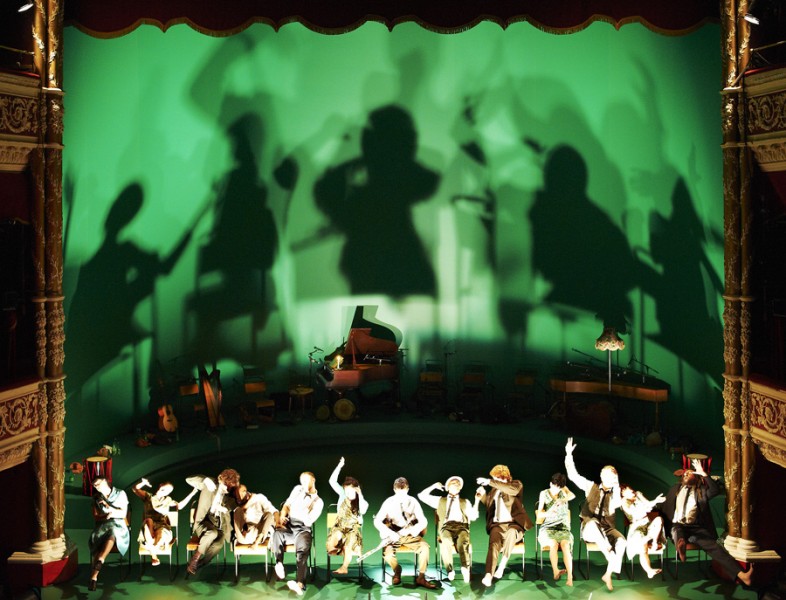
The stage layout was very striking as eerie shadows cast upon the light green backdrop helped create a feel of nature throughout the show – like how fire casts shadows upon the earth around it. Also the traditional semi-circular layout of the musicians and dancers worked well, as the audience felt as though they were taking part in a real Irish session.

There were certain aspects of the performance, however, that felt somewhat obvious and perhaps stereotypical. The nature of the stage layout made it difficult to see the whole performance at times; and there were some musical faux pas in terms of harmony. The ending of the performance was somewhat misleading as after the cast took their bow the show continued on, which was fortunate as the audience was then asked to come up on stage and dance with the cast. As minor as these flaws were, they were trifling compared to the overall performance of this outstanding show.

Rian gives a beautiful impression of the Irish culture and spirit. The performance offers an open and inclusive look into the Irish community. The dancers’ vivacious performance created an excitement in the audience and throughout the performance you had to suppress the urge to jump on stage and join the dancers. At the end, we finally were given this chance! Overall, this performance left an imprint on its audience and we highly recommend you to go and see it.

Image

A Matter of Record

Record

Dylan Tighe
Half Moon Theatre
Reviewed 23 June 2012

by Sadhbh Keating,Amaka Attoh,Kim Molloy,Eimear Deery

Record by Dylan Tighe is an extremely difficult performance to critique as it is an autobiographical, emotional play about Tighe’s struggle with bipolar disorder. Also, we must note that we saw only the second preview and the production may change, and grow.

The setting is, for the most part, drab. The pre-set is very intimate; it feels like Tighe’s personal space. Guitars, a drum set, a large writing desk and a leather chair all dressed in dark colours reflect the melancholic mood of the show.

Tighe uses music from his debut album Record, his own medical records, and multimedia to portray the concept of mental illness. Tighe takes on the role of himself which provides authenticity and real raw human emotion. This also highlights the isolating and internalised nature of this disease. Keeping with the intimate nature of the performance, the supporting cast of musicians and actors is very small. Aofie Duffin takes on the role of Tighe’s nurse and love interest but, unfortunately, her performance lacks credibility. A more positive point of Duffin’s performance is her singing voice. Her hauntingly beautiful voice captures the turmoil of emotions her acting didn’t. Daniel Reardon takes on the role of the austere doctor and gives a satisfactory performance.  Despite the small cast of supporting actors and their inability to effectively portray the story, powerful messages still come through, one being that medication may not always be effective to treat mental illness.

Elements such as Tighe’s own music also reinforced these messages and provided clarity to some of the more obscure images. Custom-made films about Tighe’s life and his ideas show his confusion and loneliness when in a depressed state, which gives the show a sense of reality. Tighe must be commended for this fearless production as he puts everything on the table.

Although the production deals with dark matters, humour and live music give it an uplift. We recommend it, although during parts of the show fantasy and reality collide, leading to confusion and ambiguity. This mirrors Tighe’s state of mind at the particular point in his life, and leaves the audience with much to contemplate.


Cork Midsummer Festival – From a Young Critic

I can honestly say that the weekend I spent with Young Critics at the
Cork Midsummer Festival was one the best of my young life so far. I was challenged by all four of the productions we attended to go outside my comfort zone physically and mentally. I was left thinking deeply about things such as mental health, what is means to be Irish, the materialistic values of today and lives that dwell behind closed doors.


My weekend began with a bus trip for me to ponder over what was ahead. I was excited and glad to be meeting my fellow young critics again. Together again for the first time in two months, we headed with Alan,Diane and Mirjana to our accommodation Victoria Lodge at UCC. Waiting for us there were welcome packages from the kind people of Cork Midsummer Festival, as well as complimentary food!

Image


After being fed and watered, we trundled along to the Camden Palace Hotel, a quirky arts centre where we met up with Karen Fricker and took part in a workshop about the piece we were to see that night –Fabulous Beast’s Rian. This workshop was substantially more physical than previous ones; we explored the idea of abstract expression through movement. We discussed what Irish music meant to us all, our concepts of dance and watched an introductory film about Rian. We were truly pepped up at this point for a spectacular performance – and that it was.

Rian was one of the best performances I have ever witnessed. There was such a natural energy onstage, and the performers showed nothing but absolute joy in every single movement they made. Traditional Irish music and contemporary dance are not two things I have ever shown much interest in, nor did I ever think they could have meshed so well together! Liam Ó Maonlaí did Séan Ó Riada proud, amalgamating music of all cultures with traditional Irish. I was struck with a great sense of beauty at this magical performance, and the simplicity of human movement. To make a wonderful night even more so, the audience was invited onstage to share in the fabulous art of dance and we were joined by the director Michael Keegan-Dolan. It was a night that will stay in my memory for a long time.

Home we came to Victoria Lodge, still buzzing but in desperate need of sleep, some of us being up since as early as 06:00am. The next morning was an early one, and we trekked to Cork School of Music for the second workshop of the weekend to discuss our thoughts about Rian. We then turned our focus to the Parallel Cities project and to Dylan Tighe’s production of Record, and created some ideas as to what we were expecting.

Parallel Cities was a new experience for us all – Shopping Centre was an immersive performance, in which we took a set of headphones and a pocket radio and were instructed on how to act in a particular shopping centre in Cork (location top secret). It was great fun acting as an agent of the underground, but there was also a clear message in this piece: that consumerism and materialism has taken a hold of modern life, and that we are becoming slaves to our relationships with items rather than with people.

The other Parallel Cities piece we ‘saw’ was House, which gave a look into true life stories of various people living in Cork at the moment. I enjoyed the simplicity of this piece; we stood with headphones outside a house and observed the lives inside. The piece took me out of my own mind and reminded me of the importance of everyone’s story.

Between these two pieces we went to see a preview of Dylan Tighe’s Record. This play really struck a chord with me, if you will excuse the pun. The truth of Tighe’s life is literally laid bare for the audience to see in this piece, as he delves into his struggle with mental illness and the Irish health system. There was a complete connection made between man and audience through his heartfelt music and lyrics. Record made me think a lot about the complexity (and often the torture) of life, and this was succeeded through satirical humour as well as tragedy. Despite the pain and suffering, hope was the last note sounded in the play. The necessity of the ability to love dominates the message board of Record’ and I know will never listen to Fleetwood Mac’s ‘Need Your Love So Bad’ without thinking of Dylan Tighe.

The morning of the 24th was another early one in Cork School of Music again for our final workshop. We split off into smaller groups and were given the challenge of composing a review of one of the four pieces in just 40 minutes. It was such a thrill getting our reviews in on our first real deadline, and we were sixteen happy young critics that afternoon! We travelled to the bus and train stations and said our goodbyes, promising to keep in contact and keep critiquing.

As great as I thought the first weekend in Dublin was, Cork was twice that. It is really such a beautiful city, and the artistic opportunities available are enough to tempt me to move there! I loved the raw honesty I found in every one of the productions we went to see, and I cannot thank NAYD and Cork Midsummer Festival for giving me this invaluable experience. I feel myself coming away from Young Critics enriched with different tastes of theatre, and with an unending appetite for more.

Madi O’ Carroll, County Wexford Youth Theatre