
Invitation to a Journey. Reviewed by NAYD Young Critic Ciara Lummis
Invitation to a Journey
CoisCéim, Fishamble, Crash Ensemble & Galway International Arts Festival
Project Arts Centre, Temple Bar
Reviewed on 21 July 2016
€22 million – the figure Eileen Gray’s Dragon Chair sold for in 2009. That’s all most people know about her. This production uncovers a great deal more than this fact, exploring the personal encounters in Gray’s life and sharing the accomplishments of this Irish artist with the Irish public.
Invitation to a Journey explores Gray’s life in vivid detail, from her colourful relationship with Damia, her French lover (portrayed powerfully by Kate Brennan), to her innovative career as an architect and designer. It is a co-production of Fishamble: The New Play Company, CoisCéim Dance Theatre, the contemporary music group Crash Ensemble and Galway International Arts Festival, and is written and performed in a groundbreaking way. The roles of the three dancers, three actors, and four musicians are melded to the extent that in some scenes it is difficult to tell them apart, especially in one scene where Damia and the dancers fight over a chair, all essentially becoming dancers.
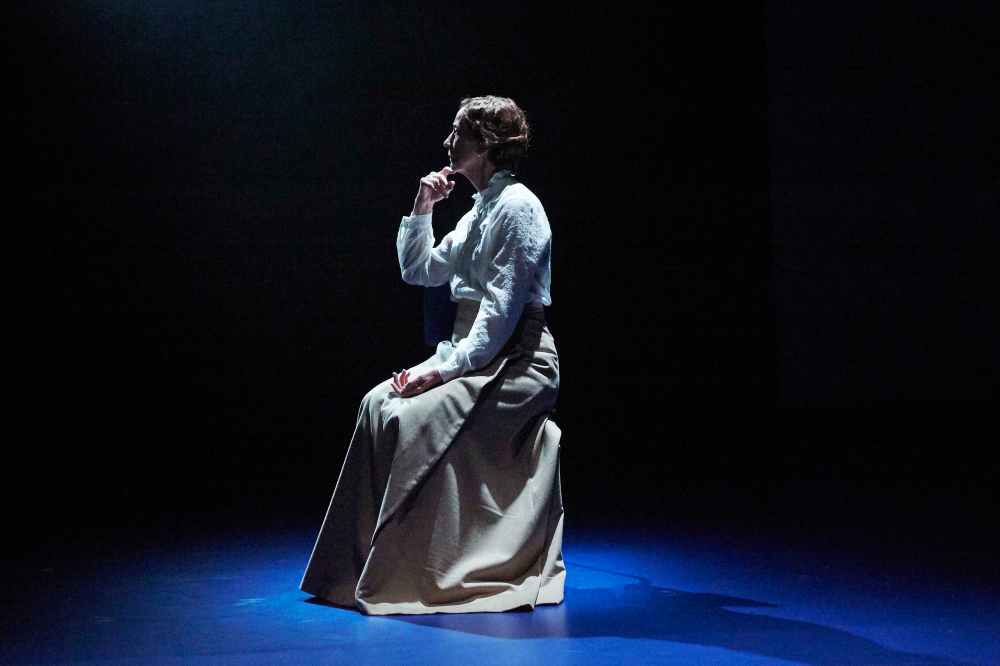
Invitation to a Journey. Photo: Ros Kavanagh
The musicians wear costumes suited to the era and have their hair crimped in a ‘20s style, which connects them to the dancers in particular, as they have the same hairstyle. (In the interest of full disclosure, I will say that my mother Deirdre O’Leary was involved in this production as one of the musicians).
The show opens with the three dancers offering their interpretation of Gray’s architecture through movement. Half a dozen nine-foot-tall doors on either side of the stage are then flung open by the remaining cast members, which segues into the auction of the dragon chair. As the cast bid for the chair, Ingrid Craigie — the actor playing Eileen Gray — sits in a chair behind them and becomes fleetingly visible as the bidders exit the stage and the lights dim. Her presence becomes much stronger as the show progresses, although at times that presence is overshadowed by the sheer amount of things going on onstage.
Halfway through, the show enacts the construction of e.1027, the iconic house Gray designed for herself and her lover the Romanian architect Jean Badovici. String outlining the foundations is taped to the stage by one of the dancers as Gray struts around the stage carrying blueprints. Only shortly afterwards, Le Corbusier (played by Ronan Leahy) paints lewd murals on the pristine walls of e.1027, nude.

In an era when most women were married off, Eileen Gray was openly bisexual, almost insanely driven, and creative. She was modern when it wasn’t mainstream and this show echoes that crazy creative determination that possessed her. While this show ambitiously melds the roles of dancer, actor and musician, it would be interesting to see what the difference in dynamic would be if the musicians had more dialogue with the rest of the cast and if Gray was more involved in scenes with the dancers. The mixture of concrete and abstract information presented through the different art forms gave a strong impression of someone’s personality. It seemed to be trying to express an inner creativity and drive that I now associate with Eileen Gray.

Ciara is an NAYD Young Critic for 2016 and a member of Fracture/ Play Youth Theatre in Tipperary
Come join Ciara and all our Young Critics on October 9th at 1pm at Project Arts Centre. They will be critiquing three productions as part of Dublin Theatre Festival 2016.


 Youth Theatre Ireland Young Critics